Architecture Residencies in Germany
16 residencies for architecture artists in Germany.
Browse real reviews from artists who attended architecture programs in Germany. Find the right residency for your practice.
Which Germany residency actually fits a architecture practice? Ask in your own words — drawn from 2,200+ residencies and live open calls, grounded in real reviews.

A Place to Breathe AIR
Horb, Germany
Well-being. Our artists' house offers many perspectives: concentrating on your own artistic work. No rent to pay for studio and flat (only a flat rate for operating costs). Take advantage of exhibition and action opportunities in the region. Solo or together with other artists. Up to three years. This is unique in Germany. Even in the case of the neighbouring Franciscan convent, the initiators were convinced that the historical building could only have a future if it was filled with life. In the case of the artists' house, too, it was originally "merely" a matter of monument protection - but then the idea of a domicile for creative minds emerged. The benefit for Horb: exchange between "foreigners" and locals, constructive togetherness, sometimes also "turmoil" in the best sense. Freelance artists from all areas of the visual arts can apply for a studio flat for a maximum of three years. The dates on which places become available are announced by the sponsoring association via the professional associations and this website. The selection is made by the artistic advisory board after an initial review by the Förderverein.
Akademie Schloss Solitude
Stuttgart, Germany
Akademie Schloss Solitude is an international and transdisciplinary artist-in-residence program in Stuttgart, Germany, awarding 50-60 residencies every two years to artists, researchers, and cultural professionals across all disciplines. It provides space for concentrated work, interdisciplinary exchange, and networking, with fellows receiving furnished live/work studios, a monthly stipend of €1,300, and travel support for 6- or 9-month stays.

Artist Stay in Weiterhagen / Western Pomerania
Weiterhagen, Germany
**Food & work materials:** the costs for food and necessary work materials are to be borne by the respective artist. **Arrival/Departure:** We are happy to help you organize your arrival/departure. If necessary, the artist can be picked up from the nearby "Buchhorst" or "Velgast" train station. There is a direct connection from Berlin/Hamburg. The costs for arrival/departure are to be borne by the artist themselves. Financial grants for guest artists for living expenses or in the form of travel or material cost grants are unfortunately not possible, as the NOVOPO project itself does not have any funding available. **Other:** two bicycles are available for use. It is particularly advantageous to travel with your own car for longer stays - in order to be mobile and flexible and not to have to rely exclusively on carpooling, for example for shopping (which is of course possible). There is no direct connection to the public transport network. The residency is in a completely isolated location with no neighbors, between the road and the forest. There are no shops within walking distance, for example. The bus stop is a bit far away and the bus only runs infrequently. The nearest supermarket in Richtenberg can be reached by bike in about 20 minutes.
Atelierhaus Hilmsen
Wallstawe OT Hilmsen, Germany
Atelierhaus Hilmsen is an artist residency program in Wallstawe OT Hilmsen, Germany, supporting the education and professional development of artists and scholars from around the world through partnerships with international institutions, emphasizing arts and humanities. Residents work in complete freedom for an intensive three-week period in spacious studios, fostering diversity, cultural understanding, and spontaneous collaborations amid a wondrous environment. Founded by artist Hans Molzberger in 1993, it offers facilities like painting studios, sculpture yards, housing, and post-residency opportunities such as exhibitions.

Bauhaus Earth
Berlin, Germany
The Experimental Fellowship at Bauhaus Earth is an international program designed for emerging practitioners in architecture, design, engineering, and interdisciplinary fields aiming to explore sustainable, regenerative approaches to the built environment. Hosted by Experimental, a Berlin-based non-profit founded by architect Prof. Regine Leibinger, the program supports fellows through financial assistance, mentorship, and access to a collaborative network. The fellowship emphasizes open-ended, practice-led research that results in tangible prototypes or architectural fragments integrating ecological and social concerns. Bauhaus Earth offers a supportive environment that connects fellows with workshops, expert advisors, and public engagement opportunities in Berlin and Brandenburg. Projects are developed in mutual collaboration with the program team and relevant stakeholders. Fellows gain visibility through exhibitions, publications, and public programming. The initiative bridges research and real-world application to rethink how architecture can contribute to sustainable futures. With a focus on material innovation, local ecosystems, and circular practices, Bauhaus Earth fosters experimental design practices that push boundaries in the architectural field.

Dekoloniale Berlin
Berlin, Germany
Dekoloniale Berlin Residency, organized by Dekoloniale Memory Culture in the City, invites artists, architects, designers, directors, photographers, fashion designers, and urban practitioners to create interventions addressing colonial histories in Berlin's public spaces, culminating in presentations at the Dekoloniale Festival. Residents receive access to a project space, curatorial guidance, production support, travel costs, accommodation, per diem, production budget, and a fee, with mandatory participation in workshops. The program typically spans about 6 months, from mid-May to mid-November, focusing on collaborative and interdisciplinary decolonial practices.

KHF Berlin – Kuenstlerhof Frohnau
Berlin, Germany
Since 2019 KHF offers a live-in guest studio in a beautiful, one-storey, half-timbered house on 155-square meters with a huge surrounding garden in the middle of the woods. Professional artists of all backgrounds are invited to apply for a self funded residency, throughout the year. There is no limitation regarding the type of artistic practice and applications from artist couples or groups are encouraged as well. Once a year there is an
Kunsthaus Tacheles
Berlin, Germany
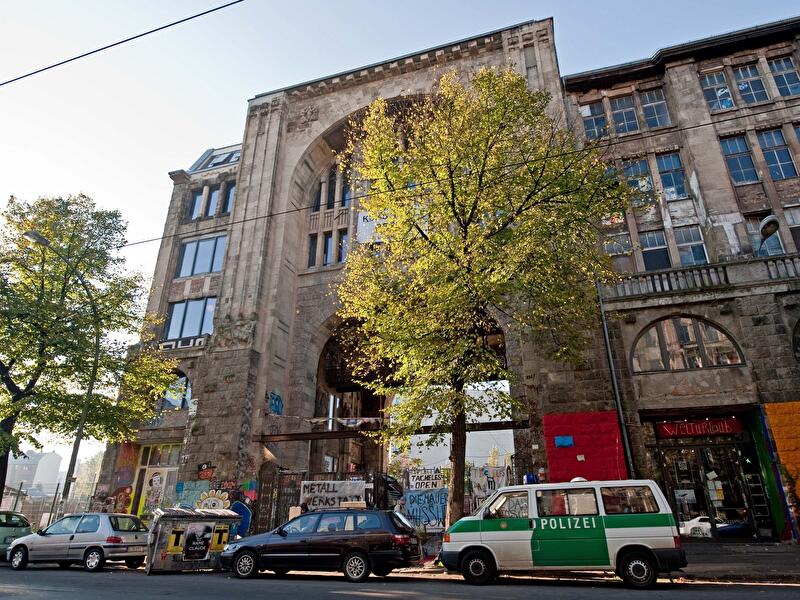
Former alternative art center in Berlin-Mitte, housed in a historic former department store. Known for studios, exhibitions, performances, cinema, and a sculpture-filled courtyard; now closed in its original form.

Petersburg Art Space Berlin
Berlin, Germany
Petersburg Art Space Berlin (PAS) is a music venue and artist residency located in Moabit, west central Berlin, offering a maximum 3-month work/live situation for experimental artists across all disciplines. The space provides two main working areas (Black Room for performances and White Room for quiet work) and hosts monthly residents showcases, fostering collaboration and creative exploration.
Pfaelzer Hof Artist Residencies
Idar-Oberstein, Germany
Pfaelzer Hof Artists Residencies is an artist-led town and cultural development project in the quarter near the station of Idar-Oberstein in the Rhineland-Palatinate region of Germany. The building is a former hotel “Der Pfälzer Hof”, which was rescued from demolition by private money and some public town funding.The town of Idar-Oberstein has an interesting history as a centre for gemstone trade and jewellery manufacturing, a specialised traditi

RaumKulturDenkmal
Breitenberg, Germany
The RaumKulturDenkmal e.V. aims to promote nature conservation, art, culture, and the protection of cultural landscapes in the tri-border area of Germany, Czech Republic, and Austria. The association is involved in cross-border projects with international participation, focusing on the preservation of endangered cultural and wild plants, the revival and restoration of historical building structures, and artistic research. The Bauhaus Bavaria Artist-in-Residence program celebrates sustainable practices and inclusive spirit, merging the ethos of the Bauhaus Movement and the Black Mountain College. The residency offers a unique opportunity for sustainable creative experimentation in a historically rich and ecologically significant location.
Spreepark Art Space
Berlin, Germany
Spreepark Art Space is a Berlin-based international residency program dedicated to interdisciplinary artistic research within a unique urban-natural setting. Hosted in the Eierhäuschen, a historic riverside building adjacent to the reclaimed Spreepark amusement park, the residency provides an inspiring environment for collectives exploring connections between people, art, and the environment. It specifically welcomes international groups of four who do not live in Berlin or Brandenburg, offering space for collaboration, experimentation, and public engagement. The program emphasizes sustainability, artistic research, and creative approaches to ecological and urban transformation. Residents are supported with complimentary housing, travel cost coverage, and a fixed living stipend. The residency culminates in a group exhibition at the Eierhäuschen the following year, showcasing research-based outcomes. Spreepark Art Space maintains a strong commitment to inclusion, welcoming applications from BIPOC, LGBTQIA+, and disabled artists, and offers visa support for non-European participants. It serves as a dynamic platform where art, planning, and nature converge within Berlin’s evolving cultural landscape.

Stiftung Starke
Berlin, Germany
The Stiftung Starke Artist in Residence program in Berlin supports emerging artists under 40 from all genres with 3-12 month residencies including free living and studio space, a stipend, and exhibition opportunities at the Löwenpalais. Established artists can access short-term guest apartments, while projects receive scientific accompaniment by international curators. Applications are accepted year-round by an independent jury, though fellows cover their own energy costs.
TAKT
Berlin; Leipzig; Zeitz, Germany
TAKT Artist Residency is an independent arts organization based in Berlin, Germany, known for fostering the growth and exchange of artists internationally. Founded in 2007, it operates in the tranquil Prenzlauer Berg neighborhood, a hub of artistic activity and cultural exchange. The residency offers various programs, including artist-led critiques, studio visits, and German language classes, aimed at enriching the participants' experience. Artists benefit from both structured programs and the freedom to explore personal projects, culminating in a group exhibition. TAKT supports a diverse range of disciplines from visual arts to literature, promoting a vibrant creative environment. The residency aims to integrate artists into the local art scene, providing them with the tools and community needed to expand their practice.
The Bauhaus Lab
Dessau-Roßlau, Germany
The Bauhaus Lab, hosted by the Bauhaus Dessau Foundation, is a research program focusing on environmental design and pedagogy. It draws inspiration from the Institut de l’Environnement, established in Paris in 1969, which was a multidisciplinary education and research center addressing ecological crises. The program seeks to relate this historical pedagogical experiment to contemporary efforts in environmentally and socially just design education. Participants in the Bauhaus Lab, comprising scholars and practitioners from various disciplines, engage in collective research to examine the history, networks, and methodologies of the Institut de l’Environnement. The program includes field trips within Germany and Europe, with the foundation covering related costs. The Bauhaus Lab offers a three-month residency with free participation, 24/7 workspace access in the Bauhaus Building, and a daily allowance. The residency culminates in an exhibition showcasing the collective research. The program, conducted in English, requires full-time onsite presence and active contribution to the research. Applications are welcomed from diverse backgrounds, and the Bauhaus Dessau Foundation supports visa formalities for non-Schengen area applicants. The selection process involves a review by an international jury and subsequent interviews. The Bauhaus Lab encourages applications that have been marginalized in academic and cultural institutions.
ZK/U (Zentrum für Kunst und Urbanistik )
Berlin, Germany
The ZK/U (Center for Art and Urbanistics) in Berlin is an artist-led, independent art residency and project space that hosts a multidisciplinary residency program. This program offers living and working space for artists, researchers, activists, and professionals from various fields, focusing on exploring city dynamics and experiences. ZK/U encourages proposals that challenge conventions and include extraordinary perspectives, welcoming conceptual, contextual, and interventionist contemporary artistic positions, as well as research or experimentation in urbanism, geography, anthropology, architecture, and the humanities. The residency program fosters mutual learning, spontaneous collaborations, and interdisciplinary exchanges, enriched by the diversity of disciplines and profiles of the residents. ZK/U, housed in a former train station building in a dynamic public park, serves as a space for urban experimentation and cross-disciplinary collaborations. With the reopening of ZK/U’s renovated and expanded public spaces in summer 2024, it will return to being a lively cultural venue hosting regular public events for diverse audiences, with residents encouraged to participate. ZK/U's conceptual framework includes narratives that define its program's themes, encouraging applicants to connect their work to these narratives. The residency offers studio space for working and living, access to communal spaces, and participation in a residency program of weekly dinners, monthly studio visits, and bi-monthly open studio events. The fees for the residency vary depending on the studio type and length of stay, covering all utility costs, space usage, and participation in the residency program. ZK/U is committed to creating an inclusive space, actively confronting and countering all forms of discrimination, and fostering good relations based on solidarity, mutual respect, and trust.
Other disciplines in Germany
Architecture residencies elsewhere
Attended a architecture residency in Germany?
Share your review