
City Guide
Örebro, Sweden
A compact Swedish city with strong public art, funded residency options, and a scene that rewards artists who like to work in public.
Örebro is a good place to land if you want time, structure, and a real audience. It is large enough to have museums, galleries, transit, and an active cultural office, but small enough that you can actually get to know the place. For artists, that mix matters. You are not disappearing into a big capital city; you are entering a city and county that can still feel legible after a week or two.
The main draw is simple: Örebro takes contemporary art seriously in public space. The city is home to OpenArt, one of Scandinavia’s most visible public art biennials, and the county has an established residency program that brings international artists into direct contact with local institutions, communities, and makers. If your practice benefits from conversation, visibility, or site-specific work, Örebro gives you that.
Why Örebro works well for residencies
Örebro sits at the center of Sweden’s inland transport network and serves as the administrative center of Örebro County. The city itself has roughly 150,000 residents, which makes it substantial without being overwhelming. You can walk or cycle much of it, and public transport is straightforward. That practical scale is part of the appeal: you spend less energy getting around and more energy making work.
The city is also known historically as the “city of shoes and biscuits,” which sounds charmingly odd, but the bigger point is that Örebro has a long industrial and civic history. That mix shows up in the residency landscape. Local programs often connect artists not just to studios, but to museums, schools, workshops, heritage sites, and public venues. You are rarely working in isolation.
For many artists, that is the real value of Örebro. The residency model here tends to include exchange. You are expected to meet people, talk about your process, and share something with the public. If that sounds energizing rather than exhausting, you will probably do well here.
The residency to know: AiR in Örebro County
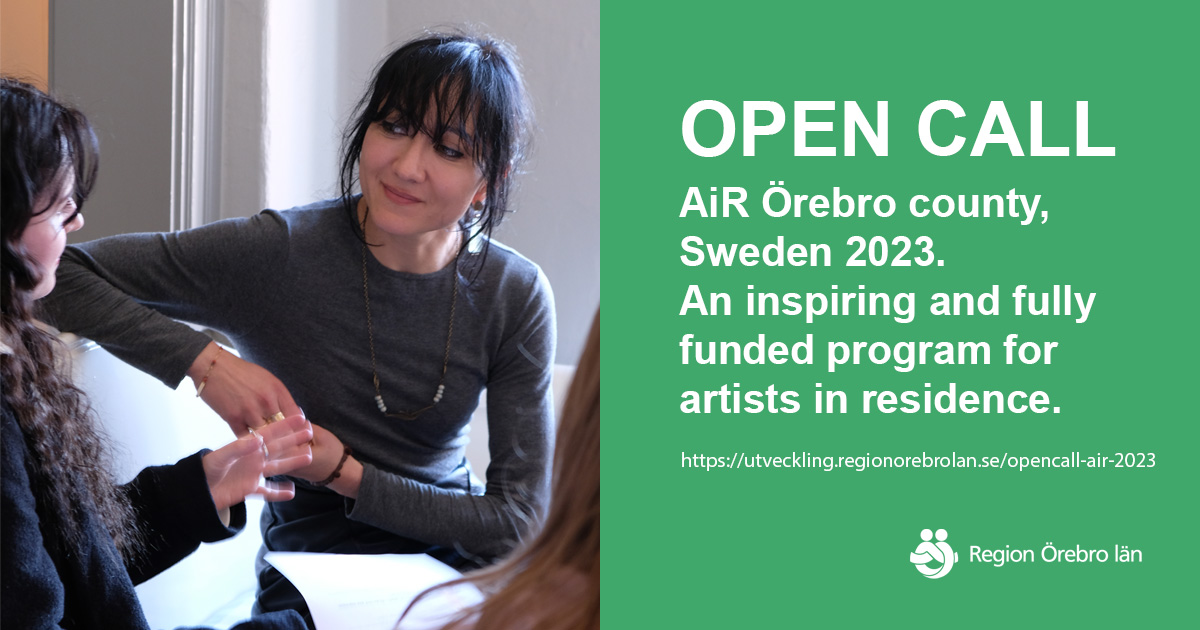
The clearest and most established residency connected to Örebro is AiR in Örebro County, run by Region Örebro County. It is international, interdisciplinary, and open to contemporary artists, craftspeople, and designers. The program typically invites a small group of residents, which keeps the experience focused rather than crowded.
What makes it especially strong is the support package. The residency is fully funded and includes a working stipend, accommodation, travel expenses, and studio or workshop space adapted to the needs of the artist and site. That matters. You are not just being offered a place to sleep; you are being given conditions to produce work.
The structure is also artist-friendly. The program usually includes an introduction and networking phase followed by a longer work period. That first stretch helps you meet people, understand the context, and start shaping the project before you settle into studio time. It is a sensible setup if your work benefits from research on the ground.
Expect public-facing components. Residents are generally asked to give a public lecture or presentation and to take part in network meetings. In some host sites, there may also be an exhibition or final presentation. That kind of expectation can be useful if you want your residency to lead somewhere concrete, not just sit in a folder of “research.”
What kinds of artists fit this program
- Artists who are comfortable working in public or semi-public spaces
- Practitioners interested in community engagement or exchange
- Craft and design artists who need workshop access
- Installation, research-based, and socially engaged artists
- Artists who like a clear structure and local contact
One important detail: the program is open to non-Swedish citizens, and English is the working language. That makes it accessible for international artists, but it also means you should be ready to communicate clearly and handle collaboration across language and cultural differences.
The local settings around Örebro County
AiR in Örebro County is not limited to one studio in the city. The host sites shift across the county, and that is part of the appeal. You might find yourself in a university city, a heritage village, a former industrial site, or a smaller municipality with a very different pace from central Örebro.
Examples from the program’s host locations include Hällefors, Frövifors, Nora, and Örebro itself. Each has a different atmosphere. Hällefors brings mining history and a more layered industrial backdrop. Frövifors connects to a paper mill museum and workshop culture. Nora has a heritage-town feel and links to regional art activity. Örebro itself offers more urban visibility and the pull of OpenArt.
If you are the kind of artist who needs a strong site to work against, this matters a lot. The residency is not just about access to a studio; it is about how that studio sits inside a place. Some hosts offer museum settings, some offer workshop environments, and some place you closer to festival activity and urban audiences.
OpenArt and the city’s public art identity
You cannot talk about residencies in Örebro without mentioning OpenArt. It is the city’s signature art event and a major reason Örebro stands out on the map for public art. OpenArt turns streets, squares, rooftops, parks, shopfronts, river edges, and indoor venues into exhibition space. That changes how the city feels for artists. Art is not tucked away. It is in your line of sight.
For residency seekers, OpenArt matters even if you are not directly involved in the biennial. It shapes the local art ecosystem, the way institutions think about public engagement, and the kind of work that tends to get attention. If your practice involves site-specific installation, public intervention, participatory work, or large-scale outdoor pieces, Örebro gives you a context where that language is already understood.
It also means that timing can matter. A residency period overlapping with OpenArt can give you a strong audience and useful contacts. Even outside the biennial, the city carries that public-art energy in a way that many smaller Swedish cities do not.
What to expect day to day
Örebro is practical, not polished in a glossy way. That is a plus. The city center is compact, so getting to studios, museums, and meeting points is usually manageable without a car. If your residency includes housing, you may be able to move through the whole stay on foot or by bike, which keeps the rhythm of the work simple.
Accommodation and studio details will vary by host site, so ask practical questions early. Is the studio private or shared? Can you make wet work there? Is there ventilation, power, storage, or access to tools? If you work with ceramics, print, sound, or large materials, this is not a minor detail. It is the difference between a smooth residency and a frustrating one.
Food and general living costs in Sweden are not low, but Örebro is usually more manageable than Stockholm. A fully funded residency goes a long way here because the city is not priced like a capital. That makes it easier to focus on the work rather than watching every expense.
Getting around and planning logistics
Örebro is well connected within Sweden by train and bus, and the city’s central location makes travel relatively straightforward. For international artists, the most common route is usually through a larger Swedish airport, then onward by rail or road. Once you are in the city, daily movement is easy enough.
If you are bringing work, confirm logistics before you arrive. Ask whether the host can receive shipments, whether there is a loading point, and whether local tools or equipment are available. Do not assume you need to ship everything. In many cases, it is easier to bring essential materials and buy or borrow what you can locally.
Visa and permit questions depend on your citizenship and the length and structure of the residency. If you are outside the EU/EEA, make sure you know whether the residency is treated as paid work or cultural exchange, and get written documentation from the host. If the residency includes a stipend, that can affect the visa category you need.
Who gets the most out of Örebro
Örebro is a strong fit if you want:
- a funded residency with real production support
- public presentation and audience contact
- access to institutions and local collaborators
- a city-scale environment that is still manageable
- connection to a broader county context, not just one studio
It may be less compelling if you are looking for a highly commercial gallery circuit or a remote, self-contained retreat. Örebro is active rather than isolated. The city gives you structure, but it also asks you to participate.
That is the basic trade here, and for many artists it is a very good one. You get a place that can support making, thinking, and meeting people without the noise of a huge metropolis. If your work benefits from public space, collaborative process, or a strong local frame, Örebro is well worth your attention.
For a residency in this part of Sweden, AiR in Örebro County is the key program to watch. If you want a place where the infrastructure is solid and the art context is visible in daily life, this city gives you a lot to work with.
Explore Sweden
More city guides
Opportunity Intelligence
Ready to find your next residency?
Get a personalized shortlist — scored against your practice, discipline, and what you need right now.
See how Intelligence works →