City Guide
Ballinskelligs, Ireland
A practical guide to retreat-style residencies on Ireland’s Atlantic edge
Why Ballinskelligs pulls artists in
Ballinskelligs sits out on the Iveragh Peninsula in southwest Kerry, in a Gaeltacht area where Irish is part of daily life and the Atlantic is basically a collaborator. You go here for space, not for scene. Expect cliffs, big skies, quick-changing weather, and an overall feeling that you’ve stepped out of your regular timeline for a while.
The art ecosystem here is built almost entirely around the Cill Rialaig project: a restored pre-Famine village turned artist retreat, plus a linked arts centre and print facility in the nearby village. It’s a long-running, well-known hub that has hosted thousands of artists across visual art, writing, music, film, and more.
If your work thrives on solitude, repetition, and a strong sense of place, Ballinskelligs makes a lot of sense. If you need cafes, public transport, and spontaneous openings, it will feel very remote. This guide is here so you can decide which side you’re on.
Cill Rialaig Artist Retreat: the core residency
Cill Rialaig is the residency most artists mean when they talk about working in Ballinskelligs. It’s a small cluster of stone cottages on Bolus Head, built from the ruins of an 18th-century pre-Famine village, high on a cliff overlooking the Atlantic.
What Cill Rialaig actually is
The Cill Rialaig project was founded by Noelle Campbell-Sharp as a contemporary arts retreat, and is run as a charitable initiative. Over the years, it has hosted thousands of creatives: painters, writers, photographers, choreographers, potters, composers, filmmakers, poets, and mixed-practice artists from Ireland and far beyond.
The retreat is intentionally stripped back. Think self-contained cottage-studios, solid essentials, and not much else. Many descriptions mention no television, no landline, and no internet in the houses, specifically to protect that “eremitic-like” focus the project is known for.
Who the retreat suits
Cill Rialaig is a good fit if you want:
- Long, uninterrupted work days with no schedule except the one you set.
- Isolation that supports deep concentration or reflection.
- Landscape-driven research for painting, photography, sound, or writing.
- Time off the grid from teaching, client work, and constant messaging.
It particularly suits painters, writers, printmakers, photographers, composers, and any self-directed artist who doesn’t need a lot of technical infrastructure beyond what they can bring.
It’s less ideal if your practice relies heavily on fast internet, large fabrication facilities, or tight collaboration with other people on-site.
What you get as a resident
Expect a living-working cottage rather than a separate apartment and studio. The units usually include:
- A simple bedroom or sleeping area.
- A basic kitchen for self-catering.
- Work space: table, desk, and floor space appropriate for many forms of studio practice.
- Heating fuel options, often with a stove or hearth, especially valuable outside summer.
There is also a communal house known as Tig an Comhrá (roughly, the conversation house). That’s the informal social anchor where you might find:
- Other artists gathering for chats, shared meals, or impromptu show-and-tell.
- Local visitors, including musicians, storytellers, and neighbours connected to the project.
- A small library and reference material.
The balance is very much up to you: some people keep to themselves and treat it almost like a silent retreat, others lean into that mix of solitude and occasional communal evenings.
Costs and money questions
One of the defining features of Cill Rialaig is its cost structure:
- Accommodation: provided free of charge to selected artists.
- Utilities / service fee: usually a modest contribution, often mentioned as a small utilities fee.
- Food & daily living: entirely your responsibility.
- Travel: you cover transport to and from Ballinskelligs, and any local travel while you’re there.
- Materials: bring what you need, especially anything specialized.
- Heating fuel: if solid fuel or similar is needed, that tends to be your cost too.
Some special residency partnerships occasionally cover utilities as well (for instance, certain writer-focused programs), but the standard expectation is that you pay the small service fee and your living costs.
Expectations and outcomes
Cill Rialaig’s ethos is explicitly about making space, not demanding output. There is typically no requirement to produce a finished body of work, no obligatory open studio, and no public-facing project unless you or a partner program choose to organize something.
This can be powerful if your practice needs time to reset, research, or reorient, and you don’t want a residency to turn into a production sprint. That said, the intensity of the place tends to push work forward anyway, simply because you’re in it full-time.
The wider Cill Rialaig ecosystem: arts centre and print studio
The retreat village up on Bolus Head is only part of the picture. The broader Cill Rialaig project also includes an arts centre and a printmaking facility down closer to Ballinskelligs village.
Cill Rialaig Arts Centre
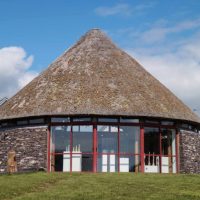
The arts centre functions as the more public face of the project. It typically includes exhibition space and retail or sales areas for work connected to the residency network. While the retreat itself is about privacy, the arts centre creates a bridge between resident artists and audiences.
This can matter to you if you’re interested in:
- Potential exhibition or sales opportunities linked to your time in Ballinskelligs.
- Connecting with the broader arts community that has grown around the project over decades.
- Seeing work made by previous residents, which can be useful context when you arrive.
The arts centre also anchors the project within the local community, attracting visitors and giving the residency a visible role in the area’s cultural life.
The print shop / Cló Cill Rialaig
Printmakers often talk about the Cill Rialaig print facility in Ballinskelligs, sometimes referred to as Cló Cill Rialaig or simply the print shop. It’s described as spacious and well-equipped for monoprinting and etching, and artists who plan to use it usually need to pre-book.
If your practice is print-based, this is a big plus. A typical pattern for printmakers is:
- Live and think in the cliffside cottage-studio.
- Plan work, draw, and prepare plates or imagery up at the retreat.
- Schedule focused days in the print studio down in the village when access is booked.
Check in advance with the project about current access conditions, any fees, and what materials or plates you’re expected to bring versus what is provided on-site.
Practicalities: living and working in Ballinskelligs
Ballinskelligs is remote and that’s the point. But to make it work for you, you need to plan properly around daily life, logistics, and timing.
Getting to Ballinskelligs
For most international artists, the route looks roughly like this:
- Fly into Kerry Airport, Cork Airport, or Dublin.
- Travel on to County Kerry by rental car, bus plus car, or a combination.
- Drive to Ballinskelligs and then out along the narrow roads to the Cill Rialaig retreat on Bolus Head.
There is public transport within Kerry, but Ballinskelligs itself doesn’t have city-style connections. Having a car gives you far more control over grocery trips, supply runs, and exploratory drives along the peninsula. If you don’t drive, discuss options with the residency early so you understand what’s realistic.
On-site mobility and terrain
The village is built on a hillside overlooking the sea. That means:
- Steep paths and uneven ground between cottages and around the site.
- Rugged walking routes if you go exploring the headland or coastline.
- Weather exposure: winds can be strong and conditions change fast.
If mobility or access is a serious concern for you, it’s wise to ask direct questions about specific cottages and pathways before committing. Some units and routes may be more manageable than others.
Cost of living in a remote Gaeltacht area
The cottages themselves are free to use, but daily life still adds up. A few realities to factor into your budget:
- Groceries: you’ll likely drive to a larger town such as Waterville or Cahersiveen for bigger shops.
- Eating out: options are limited compared with a city and may be seasonal.
- Fuel: if you’re there outside summer, heating costs can matter in a stone building by the Atlantic.
- Art materials: assume you need to bring anything specific with you; local shops won’t carry niche supplies.
On the positive side, the lack of constant entertainment and shopping can mean your spending is sharply focused on essentials and materials.
Studios and work conditions
The house-studios are built for simplicity and quiet concentration, not for technical spectacle. A few things to expect and plan for:
- Scale: cottages are compact; large-scale sculpture or heavy fabrication may be challenging.
- Mess: you can work, but always check what’s acceptable for paint, solvents, or dust.
- Light: changing coastal light can be incredible for painters and photographers; bring flexible lighting for night work.
- Digital work: if you rely on cloud-heavy workflows, plan for offline capacity or bring your own connectivity solution if allowed.
For sound-based work, the quiet and constant presence of the sea and weather can be a strong resource, though wind and storms can also complicate outdoor recording.
Community, culture, and how social it really is
Ballinskelligs will not give you a big urban art circuit, but there is a genuine community around the residency and local culture if you engage with it.
Artist community on-site
At any given time, several artists are usually in residence. The social rhythm tends to look like this:
- Daytime: most people work in their cottages or outdoors, often in parallel solitude.
- Evenings: some artists gather in the communal cottage for conversation, shared meals, or informal crit-type chats.
- Ad-hoc studio visits: you may invite each other into your spaces to see work developing, at whatever level of intensity suits you.
There isn’t a structured networking program; the trust is that artists can self-organize the amount of contact they want.
Local cultural context
Ballinskelligs is part of a Gaeltacht area, where the Irish language, music, and storytelling traditions are alive in everyday ways. Through the Tig an Comhrá and the arts centre, you may cross paths with:
- Local musicians and singers.
- Storytellers and culture-bearers.
- Neighbours who have known the project for years.
This doesn’t automatically translate into collaborative projects, but it offers a strong sense of being embedded in a specific cultural landscape rather than an anonymous retreat bubble.
Events and visibility
The focus is on the work you do in your own time, not on a packed public program. That said, across the wider Cill Rialaig structure you may find:
- Group or solo exhibitions linked to residency work, sometimes in the arts centre or partner spaces elsewhere.
- Print-focused showcases connected to the Ballinskelligs print shop.
- Occasional gatherings, launches, or talks that arise through specific projects or partnerships.
If public presentation is important for your funding or project, discuss possibilities when you’re planning your stay rather than assuming built-in exposure.
Timing, visas, and choosing if Ballinskelligs is right for you
When to go
The experience shifts with the seasons.
- Late spring to early autumn: more daylight, friendlier weather, easier driving, and better conditions for outdoor work and walking. Landscape painters, photographers, and anyone sensitive to damp cold will usually prefer this window.
- Autumn and winter: powerful Atlantic storms, strong winds, and shorter days. This can be incredibly atmospheric and intense, especially for writing, sound work, or studio-focused practice, but you need to be comfortable with harsher conditions and more time indoors.
Think about what your project actually requires: clear light and plein-air access, or a stormy retreat where staying indoors feels like the creative default.
Application rhythm
The main application process for the retreat traditionally runs twice a year. That means you’ll usually be planning several months ahead of when you want to be there. If you have specific season needs, build in extra lead time.
When preparing an application, it helps to be clear on:
- How your project fits the retreat’s focus on solitude and reflection.
- Why a rural, coastal, low-distraction setting matters to your work.
- How you’ll practically manage being self-directed and self-catering.
Visa and immigration basics
Visa needs depend on your nationality and the length and structure of your stay. A few general points to keep in mind:
- If you’re from outside the EU/EEA/UK, check Irish immigration rules early to see if you need a visa for a short stay.
- Clarify whether the residency involves any payment, stipend, or teaching, or if it simply provides accommodation; immigration categories can differ.
- Ask Cill Rialaig whether they can provide an invitation or confirmation letter to support visa applications or border questions.
- Make sure your travel insurance and documentation reflect that you’re on a short creative retreat, not taking up formal employment.
Is Ballinskelligs the right fit for you?
You’re likely to thrive at Cill Rialaig and in Ballinskelligs if you:
- Crave uninterrupted time with your work and are comfortable with solitude.
- Are excited by weather, landscape, and the feeling of being at the edge of things.
- Can work happily in basic, self-contained conditions without constant digital access.
- Enjoy slow, deep conversations more than busy social circuits.
You may find the residency challenging if you:
- Need regular urban stimulation, nightlife, or a tightly scheduled public program.
- Rely on large-scale fabrication, specialist equipment, or high-speed internet for your core practice.
- Prefer a highly structured residency with formal critiques, workshops, and constant peer interaction.
If you’re clear-eyed about these trade-offs, Ballinskelligs can offer something quite rare: serious time, held in a strong place, with very few external demands. That combination is exactly what many artists are trying to create for themselves. Here, it’s already waiting.