City Guide
Ventspils, Latvia
How to use Ventspils, Latvia as a focused base for writing, research, and slow, coastal work
Why base yourself in Ventspils as an artist
Ventspils is a compact Baltic Sea port city in western Latvia. It’s not a big-scene capital; it’s the place you go when you want quiet, long work days, and a specific relationship to sea, weather, and history.
For artists, the city is defined by a few useful things:
- Calm and concentration: fewer distractions, little pressure to “be seen,” easy to stay with your project.
- Coastal landscape: dunes, beaches, the port, wind, fog, and big skies that are great for long walks and site-based thinking.
- Literary infrastructure: an unusually strong setup for writers, translators, and text-heavy practices.
- Manageable scale: you can walk or bike almost everywhere you need to go.
If you want to push through a manuscript, translation, or concept-heavy work cycle, Ventspils is built for that. If you need a constant flow of openings and studio visits, it will feel quiet, possibly too quiet.
The International Writers’ and Translators’ House: how it actually works
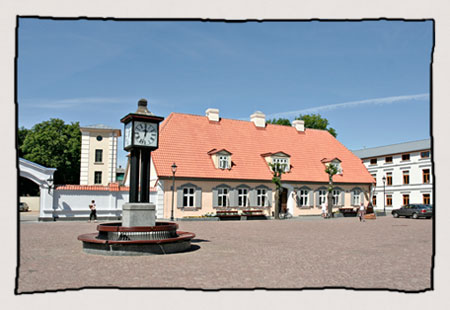
The most established residency in Ventspils is the International Writers’ and Translators’ House, often referred to as Ventspils House. It sits in the historic center, in a rebuilt former town hall from the 18th century.
Who this residency suits
This residency is tailored to literature-related work. You’ll be a good fit if you are:
- a professional fiction, non-fiction, or poetry writer
- a literary translator in any language combination
- a researcher working on literature, translation, or language-related projects
- a Latvian or international author with a clear project and track record
Visual and interdisciplinary artists can be considered if there is a clear literary or research link, but the program is not a general-purpose art residency with workshops and fabrication labs. It’s built around desks, texts, and long quiet days.
What the residency offers day-to-day
Ventspils House is set up to keep your basic needs handled so you can focus on work. According to official and partner listings, you can expect:
- Residential rooms: seven or more individual rooms with private bathrooms and Wi-Fi.
- Accessibility: several rooms are adapted for people with mobility needs.
- Shared facilities that remove daily friction:
- equipped shared kitchen
- washing machine, dryer or drying solutions, iron
- bed linen, towels, basic cleaning tools
- Work and social spaces:
- a reading room / library area
- small garden and recreation areas
- sauna (used occasionally by residents)
- Mobility: some bicycles are available, which matters a lot in a compact coastal city.
The atmosphere is quiet and collegial: you might share the house with up to nine residents at a time, often working silently in parallel, with occasional shared meals and conversations.
Stays, grants, and money questions
Typical stays are around four weeks, with some programs extending to two months when tied to specific funding. Public listings describe:
- a grant in the range of EUR 320 (post-tax) for about four weeks for selected residents
- for some Nordic-region programs, a higher grant and partial or full travel cost coverage
There is usually a small weekly accommodation fee when you don’t come on a fully-funded track. Think of the stipend as a contribution to groceries and basic living rather than a full production budget or real salary.
Questions you’ll want to ask the residency directly:
- Is the stipend paid gross or net of tax?
- Does the accommodation fee still apply if you receive a grant?
- Is travel covered, partially reimbursed, or self-funded?
- How and when is the stipend paid (bank transfer, cash, one installment vs. multiple)?
Check the official site for current terms: Ventspils House. For extra context, look at their profiles on networks like Res Artis and TransArtists.
Artistic support and expectations
There is no heavy programming schedule, which is good if you want uninterrupted work time. Support tends to look like:
- help connecting with local universities or literary programs
- possibilities to give a reading, talk, or participate in a small event
- light-structure expectations about being present and actively working on your project
You will not usually be pushed into a big final exhibition or major public project. The residency is more about giving you a stable base to write, translate, or research, with some optional public engagement if it fits your project.
How applications usually work
Public information suggests a flexible application rhythm:
- applications can often be submitted year-round
- they may be reviewed periodically (for example, every couple of months)
- some specific grant tracks have separate calls and guidelines
Typical materials you should be prepared to send:
- a concise project description (what you’ll do during the residency)
- a short bio and CV
- samples of writing or translation
- a brief explanation of why Ventspils and this house fit your project
If you are non-EU, also ask if the house can issue an invitation letter to support a visa application.
Ventspils as your temporary city: where and how you’ll live
Beyond the house itself, it helps to understand how Ventspils works as a base camp. The city is small, clean, and structured around three main experiences: historical streets, port infrastructure, and the sea.
Neighborhoods and daily routes
For residency artists, the main area that matters is the historic center / old town. From there you can walk or bike to most places you’ll use regularly:
- grocery stores and markets
- cafés and a handful of restaurants
- the riverfront and port zone
- parks and the promenade
- bus connections if you want to travel
Expect a city that quiets down early compared to big capitals. Night walks and late writing sessions are easy; late-night bar crawls are not really the point.
Cost of living for resident artists
Ventspils is generally more affordable than many Western and Northern European cities. A rough sense of what you’ll be dealing with:
- Housing: usually covered or partly subsidized by the residency, so your rent is either minimal or free.
- Groceries: reasonable; cooking at home is normal and easy with local supermarkets.
- Eating out: possible but can add up if you treat it as a daily habit; think of it as an occasional treat.
- Local transport: often just walking or biking; public buses exist but you may not need them daily.
- Materials: fine for basic stationery, printing, or minor supplies; complex art materials are better sourced in larger cities or brought with you.
Budget-wise, your main expenses will be food, some transport, and project-related costs (books, printing, materials, maybe a side trip to Riga).
Working conditions for different practices
Ventspils House is ideal for practices that center on desk work:
- writing and revising manuscripts
- translation and editing
- research, reading, and note-taking
- script or concept development, if you later produce elsewhere
If you are a visual, sound, or performance artist planning to use Ventspils as a working base, you’ll want to check:
- Can you work in your room, or is there a separate workspace with good daylight?
- Is there somewhere suitable for audio work (headphones are fine, but ask about noise rules)?
- Is there a local print shop or basic fabrication service you can use?
- Is there a space for a small showing, talk, or informal screening if your project needs it?
The residency is comfortable and practical, but it’s not a workshop with industrial tools. Think sketching, planning, writing, and light production rather than heavy fabrication.
Culture, community, and how to plug in while you’re there
Ventspils is better described as a steady cultural ecosystem rather than a high-intensity art scene. Your most important connection point will usually be the residency staff and fellow residents.
Local cultural anchors
Useful institutions and structures you can orient around:
- Ventspils Museum and affiliated spaces, which may host exhibitions and events.
- Libraries, which are often active partners for readings, talks, and workshops.
- Universities and educational programs connected to writing and translation, which sometimes collaborate with Ventspils House.
- City cultural centers, where you may find concerts, festivals, and public programming.
The residency collaborates with academic and cultural institutions, and those relationships can open doors if your project aligns with local interests.
Events and presentation opportunities
As a resident, you can often plug into smaller-scale formats like:
- public or semi-public readings and conversations
- book or translation discussions with students or local communities
- talks about your work, process, or home literary scene
- participation in literary festivals or city events when the timing lines up
These presentations are usually optional and can be tailored to your comfort level. If you want to present, let the residency know early so they can connect you with the right partners.
Finding peers and collaborators
The most immediate community will be the other residents in the house: writers and translators from different countries sharing the same kitchen and garden. If you want to expand beyond that, ask the residency to introduce you to:
- local writers, poets, and translators
- teachers and students in creative writing or translation programs
- curators or organizers working with literature, performance, or interdisciplinary projects
You can also make use of regional networks. Many artists pair a Ventspils stay with time elsewhere in Latvia, like Riga, Daugavpils, or coastal residencies. That way you get deep work time in Ventspils plus a burst of networking and production resources in a different city.
Getting there, staying legal, and timing your residency
Logistics for Ventspils are manageable as long as you plan the Riga–Ventspils leg in advance and clarify your visa status early.
How you actually arrive
Most artists reach Ventspils like this:
- Fly into Riga International Airport (RIX).
- Travel from Riga to Ventspils by intercity bus or car. The bus is frequent and straightforward.
- Walk or take a short ride from the Ventspils bus station to your accommodation.
Once in Ventspils, walking and cycling cover most needs. The city is flat enough that a bicycle from the residency will often be your main transport.
Visa and paperwork basics
Your legal situation depends on your passport and the length of your stay:
- EU/EEA/Swiss citizens: generally free movement; a residency stay is relatively simple, though you might still want insurance and proof of funds.
- Non-EU artists: you may need a Schengen short-stay visa or another permit, depending on your nationality and total time in the Schengen area.
Before you commit, ask the residency:
- Do they provide a formal invitation letter or contract for visa purposes?
- Do they have experience supporting artists from your country with visa paperwork?
- Is the stipend considered taxable where you live, and do they issue any tax forms?
Make sure you also have medical insurance that covers your full stay in Latvia, which is often a requirement for visas and simply good sense for a multi-week residency.
When to be in Ventspils
Choosing your season changes the creative experience:
- Late spring to early autumn: long days, the beach is accessible, outdoor walks are easy, and the city has more life. Great for projects that use the coast and landscape directly.
- Autumn and winter: shorter days, colder and windier, but perfect if you want deep focus, minimal distractions, and a strong maritime atmosphere in your work.
If your work depends on filming or outdoor events, aim for the lighter months. If you want to lock into a writing routine and treat the weather as a reason to stay at your desk, the off-season can work in your favor.
Using Ventspils strategically in your practice
Ventspils is especially strong when you think of it as one piece of a larger practice, not your entire ecosystem.
- Use the residency to draft, translate, or conceptually build the work in a quiet, supportively structured environment.
- Plan to produce or show larger-scale installations, performances, or publication launches in cities with more infrastructure and audiences, potentially after your stay.
- Lean on the coastal and port landscape if you work with place, memory, environment, or maritime histories.
- If you are a translator or researcher, use local connections to access Latvian texts, language courses, and expert conversations.
Ventspils suits artists who like structure but not pressure, deadlines but not spectacle, and an environment where silence, routine, and a slightly off-the-map setting help the work move forward.
Quick self-check: is Ventspils right for you?
You will probably thrive in a Ventspils residency if you:
- have a clear text-based or research project that benefits from extended focus
- are comfortable with a quiet house and independent work routine
- enjoy walking, sea air, and relatively simple daily rhythms
- don’t rely on a dense gallery scene or constant networking for the success of this particular project
It might not be your match if you:
- need studio visits, curators, or collectors dropping in regularly
- depend on specialized workshops or heavy fabrication facilities
- are looking for nightlife or a large, experimental live-arts scene during the residency itself
If the quiet and the coast sound like assets, not drawbacks, Ventspils is an excellent place to anchor a focused chapter of your practice.