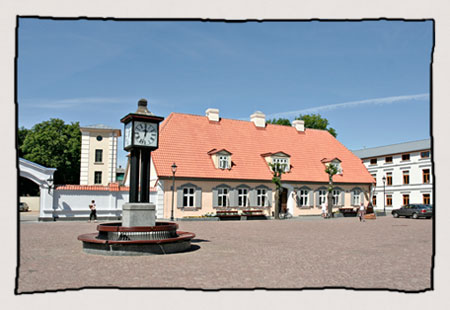
City Guide
Ventspils, Latvia
A quiet Baltic Sea city with strong support for writers, translators, and research-minded artists.
Ventspils is not the kind of place you go for a crowded studio scene or a nonstop parade of openings. You go for focused time, coastal air, and a residency structure that actually supports work. For writers, translators, and artists whose practice crosses into research, sound, or science, it can be a very good fit.
This guide keeps things practical: what the city feels like, which residencies matter, and what you should think about before you pack your bags.
Why artists choose Ventspils
Ventspils sits on Latvia’s Baltic Sea coast in the west of the country. It is a port city, but not a hectic one. The pace is slower than Riga, and that slower rhythm is part of the draw. If you need a stretch of time with fewer distractions, the city makes that easier.
The strongest artistic pull here is not a big commercial gallery network. It is a combination of quiet, institutional support, and a landscape that gives you room to think. The sea is close, the city is compact, and the residency options are unusually practical for a place this size.
- Seaside setting: Beaches, dunes, and long walks are part of daily life.
- Low-distraction environment: Good for writing, editing, translation, and research-heavy work.
- Established residency base: Especially strong for literature and related fields.
- Cross-disciplinary links: Some programs connect artists with science, technology, or local cultural partners.
- Compact city layout: Easy to get around without much planning.
For many artists, Ventspils works best as a retreat that still has enough infrastructure to support a real project. That balance is what makes it useful.
Key residencies to know
International Writers’ and Translators’ House
This is the main residency to know if your practice is literary. The house supports professional writers, translators, and literary researchers, with space for several residents at a time. It is housed in a historic building in central Ventspils, with a library, kitchen, internet access, laundry, sauna, garden, and bicycle access. Some rooms are adapted for residents with special needs.
The setup is straightforward and useful: a place to work, a place to sleep, and enough shared infrastructure that you do not have to spend energy on logistics every day. For writers, that can make all the difference.
- Good fit for: Fiction, poetry, translation, literary research, text-based projects.
- What stands out: Quiet work environment, strong literary focus, and a built-in sense of community.
- Support available: Different funding streams have offered scholarships or grants, and some programs include a Latvian language course in cooperation with Ventspils University.
- Practical features: Shared kitchen, library, laundry, bikes, and accessible rooms.
If you work in text and want a residency that feels clear, organized, and low-friction, this is the main address to look at.
RIXC Baltic-Nordic Art, Science & Techno-Ecologies Residency
RIXC is based in Riga, but its residency network is highly relevant to Ventspils because it connects artists with the Ventspils region, including the Ventspils International Radio Astronomy Center and the Irbene radiotelescope. If your work touches sound, ecology, media, digital systems, or science collaboration, this is worth paying attention to.
This is a strong option for artists who want production support and a research framework, not just a room with a desk. The program has offered fee support, accommodation, travel coverage, local transport, technical assistance, and help with public presentation.
- Good fit for: Sound art, media art, installation, performance, eco-tech practices, science-adjacent work.
- What stands out: Access to scientific infrastructure and a serious research environment.
- Support available: Fee, accommodation, travel, production support, and technical help.
- Ventspils connection: Research trips to the radiotelescope and related sites.
Even though this is not a Ventspils-only residency, it brings one of the city-region’s most distinctive assets into play. That makes it unusually relevant if your project needs both art and science.
What the city feels like day to day
Ventspils is easy to live in if you do not need a lot of urban intensity. The city center is walkable, and the coastline gives you a natural shift away from the studio. That matters more than it sounds. A residency can be technically excellent and still feel flat if the surrounding city does not support your rhythm. Ventspils usually does.
The city center is the most practical base for most visiting artists, especially if you are staying at or near Ventspils House. You are close to services, cultural institutions, and daily necessities. If your work is landscape-based, the seafront and beach areas are equally useful, especially for drawing, walking, photography, or field notes.
There is not a dense artist district in the usual sense. You are more likely to move between institutional spaces, the coast, and your residency housing than to bounce from studio to studio. That can be a strength if you need a cleaner working frame.
- City center: Best for convenience and access to institutions.
- Seafront: Best for reflective work, fieldwork, and coastal projects.
- Residential outskirts: Useful if you want more solitude or longer stays.
Cost, housing, and daily logistics
Ventspils is generally less expensive than Riga, especially for accommodation and day-to-day life. Residency housing often makes the biggest financial difference, since a lot of the basic infrastructure is already covered.
If your residency is not fully funded, it helps to think in a simple way: what is included, what is shared, and what you still have to bring. The more you can clarify before arrival, the less likely you are to lose work time to small problems.
- Accommodation: Often the main financial advantage.
- Food: Usually manageable by Northern European standards.
- Transport: The city is compact, so walking and biking work well.
- Studio needs: Independent studio spaces are more limited than in bigger cities, so residency-provided space matters.
Before accepting a place, ask what the residency actually provides. A desk is not the same as a production studio. Shared housing is not the same as a dedicated workspace. If you need tools, storage, shipping access, or help with installation, ask directly.
Getting there and getting around
The most common way to reach Ventspils is by bus from Riga. Driving is also useful, especially if you are bringing materials or want to move around the coast. Once you arrive, the city itself is manageable without a car.
Bicycles are especially useful here, and some residency houses provide them. That can make a bigger difference than you expect, especially if you plan to split your time between the center, the coast, and cultural sites.
- By bus: The simplest option for many artists.
- By car: Helpful for material-heavy projects or regional travel.
- On foot or by bike: Practical for most local movement.
If your work involves fragile objects, sound gear, cameras, or installation materials, check storage and unloading conditions before arrival. Small details can become big headaches once you are on site.
Visa and paperwork basics
If you are an EU, EEA, or Swiss citizen, short residencies in Latvia are usually simple from an entry standpoint. If you are coming from outside that zone, you may need a Schengen visa or other supporting documents, depending on the length and purpose of your stay.
The useful question to ask any host is very direct: can they issue an invitation letter, and what documentation do they need from you? If you are applying to a residency that spans several weeks or connects to a funding stream, make sure the paperwork matches the actual timing of your stay.
Do not leave visa questions until the last minute. Even when the residency itself is well organized, your travel planning still needs a buffer.
What kind of artist Ventspils suits
Ventspils is especially strong for artists who want structure, quiet, and enough institutional support to keep the work moving. It is particularly good for literary and research-led practices, but it can also work well for artists who use the city as a base for site-responsive or interdisciplinary work.
- Strong fit: Writers, translators, literary researchers, sound artists, media artists, eco-artists, and artists who like a slow, focused pace.
- Less ideal: Artists who need a dense gallery circuit, constant peer traffic, or a highly urban scene.
If you are after a residency that gives you time, calm, and enough support to actually finish something, Ventspils is a city worth keeping on your list.
Simple checklist before you apply
Before you send anything, make sure you know what kind of stay you need.
- Is your project literary, visual, research-based, or cross-disciplinary?
- Do you need a private studio, or is a writing desk enough?
- Will you need access to tools, storage, or production support?
- Is the residency self-directed, or does it expect public engagement?
- Do you need a visa letter or funding confirmation?
- Will you work better in the city center or closer to the coast?
Those questions sound basic, but they save a lot of trouble. The right residency is not just about the name. It is about whether the place supports the actual way you work.
For more context on residency options in Latvia, you can also explore TransArtists’ listing for Ventspils House, Res Artis’ listing, and the official Ventspils House site. If your practice reaches toward art and science, the RIXC residency page is the other key place to check.