City Guide
Ste.Colombe-en-Bruilhois, France
A quiet Gascony base for writers, artists, and food creatives who want to actually get work done
Why artists end up in Ste. Colombe-en-Bruilhois
Ste. Colombe-en-Bruilhois is a small rural commune near Agen, in the Lot-et-Garonne area of Southwest France. You don’t go here for museum-hopping or gallery marathons. You go because you want time, space, and a slower rhythm that lets your work actually breathe.
The area sits in Gascony’s agricultural landscape: canal paths, farms, orchards, river valleys, and those classic village markets that start to reorganize your week around fresh produce. It’s quiet but not cut off: Agen is close enough for trains, supplies, and the occasional city day.
This setting tends to attract:
- Writers who need immersion and fewer distractions than a city residency
- Visual artists who can work with relatively light equipment (drawing, painting, photography, digital, research-based practices)
- Photographers interested in rural life, food, seasons, and landscape studies
- Culinary creatives and food writers who want markets, producers, and gardens within arm’s reach
- Artists between big projects who need a retreat to reset, rethink, or finish something that’s been hanging over them
The local residency ecosystem is small and independent. That’s the appeal: less programming, more autonomy.
Relais de Camont: the core residency to know
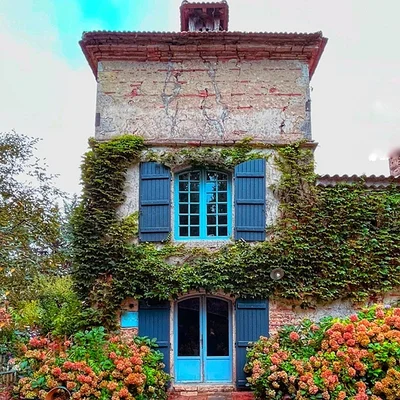
The main reason Ste. Colombe-en-Bruilhois shows up on artists’ radars is Relais de Camont, a creative residency in a restored farmhouse surrounded by gardens and countryside. It’s designed for deep-focus work rather than constant events.
What Relais de Camont actually offers
Relais de Camont is set up as a quiet residency and writer’s retreat. Expect:
- Private rooms with ensuite bathrooms – you get a door you can close, your own bathroom, and a sense of personal base camp.
- Dedicated quiet working spaces – desks and corners where you can spread out notebooks, sketchbooks, laptops, or prints without having to clear everything away for dinner.
- Shared, fully equipped kitchen – a big deal for long stays and especially for food-focused artists. Cooking becomes part of the daily rhythm.
- Expansive gardens and outdoor areas – spots to read, write, paint, or photograph in the open air when the weather cooperates.
- Wi‑Fi and heating – essential if you’re working digitally or staying in cooler months.
- Minimum stay of about two weeks, with typical residencies running two to four weeks for focused work.
It’s a small, intimate set-up, closer to a working retreat than a large institutional program.
Who tends to thrive there
Relais de Camont is especially good if you are:
- A writer or researcher working on a draft, manuscript, thesis, or long-form project that needs quiet and routine.
- A visual artist who doesn’t need heavy equipment: painting, drawing, collage, small-scale sculpture, textiles, photography, or digital work translate well here.
- A photographer interested in rural France, slow tourism, food culture, and daily life rather than big-city street photography.
- A food creative or food writer who will actually use weekly markets, local producers, and the potager and herb gardens as a living lab.
- An independent worker who doesn’t need constant schedule prompts, critiques, or formal mentorship.
If you crave busy programming, large peer cohorts, and public-facing outcomes like exhibitions or performances, this probably won’t satisfy you. It’s more “quiet and steady” than “festival energy.”
Atmosphere and working rhythm
Relais de Camont is framed as a quiet, supportive place to create. Think:
- Long, uninterrupted blocks of work time, broken up by simple rituals: coffee, walks, cooking, markets.
- Communal spaces like the kitchen and sitting room where you can connect with whoever else is in residence when you feel social.
- Outside space where you can shift locations during the day – garden tables for editing, orchard edges for sketching, or just a different view when your draft stalls.
The setup encourages independent daily routines. You can build your own structure: for example, writing early in the kitchen as the light changes, then moving outside with a sketchbook, then editing at a desk in the afternoon.
How it’s framed publicly
You’ll find Relais de Camont listed both on its official site and on directories like Transartists. Those listings confirm:
- The rural, retreat-style character of the residency
- The two-room structure with ensuite bathrooms and dedicated workspaces
- The minimum stay of about two weeks
- The emphasis on quiet, independent work
Checking both sources is useful for up-to-date practical details and to see how the residency describes its own priorities.
Working in and around Ste. Colombe-en-Bruilhois
Since the commune is small, you’ll likely divide your time between the residency, the immediate countryside, and the nearby town of Agen. Planning for that mix helps you get the most out of your stay.
Cost of living and budgeting
The area is significantly more affordable than major French cities. That said, rural life has its own cost structure. When you budget, think in terms of:
- Residency fees – your biggest fixed cost. Factor in the full length of your stay and any deposits.
- Travel – trains or flights to France, then onward travel to Agen and finally to the residency.
- Local transport – car rental is often the most practical solution, especially if you want freedom to explore markets and nearby towns.
- Groceries and markets – you can eat well without spending a lot if you cook and buy at local markets.
- Materials – it might be easier to bring most of what you need or ship a small box of essentials instead of hunting for specialized supplies on arrival.
Dining out and cafés are usually cheaper than in Paris or Bordeaux, but you won’t be surrounded by endless options. Cooking at the residency becomes a core part of the rhythm.
Where artists actually stay
Ste. Colombe-en-Bruilhois is not big enough to have distinct “artist neighborhoods.” For residency artists, it usually comes down to three options:
- Staying at Relais de Camont for the full period of your residency. This is the most straightforward and keeps your focus tight.
- Adding time in Agen before or after the residency. Agen gives you more urban texture, plus easier access to galleries, cinema, and culture if you’re decompressing after a heavy work phase.
- Other rural accommodation nearby, if you want to extend your stay quietly and keep working on your own.
If you need a base with more amenities during a longer French trip, Agen is usually the most practical anchor.
Studios and workspaces
Your main workspace will almost certainly be the residency itself. Relais de Camont offers:
- Individual quiet workspaces in or near your room – best for writing, drawing, planning, digital work.
- Communal areas that can double as informal studios – kitchen tables, sitting rooms, outdoor tables.
- Garden and surrounding landscape – an extended workspace for plein-air painting, photography, or observational drawing.
The model here is more “retreat studio” than “fully equipped production facility.” If you require a kiln, darkroom, printshop, welding setup, or large-scale fabrication tools, you’ll need to plan workarounds or treat this residency as the research, writing, and planning phase of a project rather than the fabrication phase.
Art scene, context, and how to plug in
Ste. Colombe-en-Bruilhois itself does not offer a dense gallery scene or constant art events. The context is quieter and more diffuse. You get access to agriculture, markets, and everyday rural routines instead of a packed openings calendar.
Using Agen and the region
Agen is your nearest city-scale resource. Artists working out of Ste. Colombe-en-Bruilhois often depend on Agen for:
- Art supplies and hardware – basic materials, tools, and office supplies.
- Culture – museums, occasional exhibitions, cinema, performances.
- Connections – potential visits to local art spaces or informal meetups with artists based in or passing through the region.
If you’re planning to show work, host a talk, or explore more institutional contexts, you may want to schedule short trips to larger cities like Bordeaux or Toulouse, which have more established art infrastructures. From Ste. Colombe-en-Bruilhois, that usually means a train from Agen and a full day out.
Local rhythm and informal networks
In this area, you’ll get more out of the residency if you treat daily life as part of your research:
- Weekly markets – great for sketching, photography, sound recording, or simply observing how the community moves through the week.
- Producers and artisans – helpful for food-focused practices and any work that engages with agriculture, craft, or rural economies.
- Shared meals – if there are other residents, dinners can become informal crits, idea exchanges, or language practice sessions.
- Walks and solo fieldwork – the canal, fields, and small roads are ideal for gathering visual or written material.
The lack of a big official art scene can actually be a plus if your practice currently needs observation, reflection, or writing more than it needs networking.
Getting there, getting around, and visas
Because the residency is rural, logistics matter. Planning them well in advance makes the actual creative work much smoother.
How to reach Ste. Colombe-en-Bruilhois
Most artists arrive via:
- Agen railway station – your main regional rail entry point. From there, you typically transfer by car or taxi to the residency.
- Larger cities like Bordeaux or Toulouse – useful for flights and high-speed rail connections. From those cities, you can take a train to Agen.
When you’re planning your route, build in a buffer day in case of delays. It also gives you time to get your bearings, stock up on basics, and adjust before you start your work block.
Mobility once you’re there
Public transit in rural areas is limited compared to big cities, so think realistically about how mobile you need to be.
- Car rental – ideal if you plan regular trips to markets, nearby towns, or fieldwork sites. It adds cost but gives you flexibility.
- Cycling – can work for shorter distances and local errands, depending on your comfort level with rural roads.
- Taxis or rides from the residency – fine for occasional transfers, but not a daily solution.
If your project depends on visiting specific sites, producers, or towns, map everything in advance and decide if a vehicle is non-negotiable for your stay.
Visa basics
If you’re based outside the EU/EEA/Switzerland, you’ll need to plan your stay around current French entry rules.
- Short residencies (around 2–4 weeks) often fit within a standard Schengen short-stay framework, depending on your passport and overall time in the Schengen area.
- Longer stays or multiple residencies might require a long-stay visa. This is especially relevant if you’re combining several projects across France or Europe.
For any visa that requires documentation, check with the residency:
- Can they provide an invitation letter and confirmation of dates and accommodation?
- Do they have experience supporting visa applications for artists?
Always verify current visa conditions for your specific nationality before committing to dates or tickets.
When to go and who this area suits
The timing of your stay shapes your daily routine, the landscape, and how you’ll work.
Seasons and working conditions
- Spring – comfortable temperatures, a lot of color in the landscape, good for photography, plein-air work, and gathering new material.
- Early autumn – mild weather, harvest activity, and strong themes for anyone working with food, agriculture, or seasonal cycles.
- Summer – long days and active markets, but potentially hot. If you’re heat-sensitive or rely on cool studio time, ask about indoor comfort.
- Winter – quiet, introspective, and good for writing-heavy projects. Check heating and local service hours, and assume fewer distractions and less going out.
For popular periods, you’ll want to secure your dates several months ahead, especially if you need a specific timeframe for a draft or project milestone.
Who Ste. Colombe-en-Bruilhois is actually good for
This area is a strong fit if you are:
- A writer, researcher, or theorist who benefits from solitude and simple routines.
- A painter or illustrator who works well with natural light, small-scale setups, and outdoor studies.
- A photographer focused on landscape, food, rural life, and slower-paced narratives.
- A culinary artist or food writer using gardens, markets, and local producers as your material.
- An interdisciplinary artist working across text, image, and research with minimal equipment needs.
It’s not ideal if your current project requires:
- Industrial-scale fabrication or large workshops
- A packed calendar of openings, studio visits, and networking events
- Late-night urban life or quick access to a big institutional art ecosystem
How to approach a residency here strategically
If you decide Ste. Colombe-en-Bruilhois and Relais de Camont match your practice, it helps to go in with a clear framework.
- Define a specific project phase – for example, “finish first draft,” “develop a new series of small works,” or “gather field research for a larger project.” The rural pace is perfect for well-bounded goals.
- Bring only what you’ll actually use – luggage and shipping add up. Plan a focused kit of tools and materials that match your goals.
- Plan your weeks loosely – build a simple weekly rhythm around work blocks, markets, walks, and rest. Leave room for unexpected ideas.
- Use the region as content, not distraction – treat markets, landscapes, and daily routines as material for your practice, not just background scenery.
Handled this way, a quiet residency in Ste. Colombe-en-Bruilhois can become a strong anchor in your practice: a place where you actually finish things, think clearly, and reconnect with why you make work in the first place.
Explore France
More city guides
Opportunity Intelligence
Ready to find your next residency?
Get a personalized shortlist — scored against your practice, discipline, and what you need right now.
See how Intelligence works →