City Guide
Krems, Austria
How to make the most of a residency in Krems, from AIR Niederösterreich to the Wachau landscape
Why Krems is on so many artists’ radars
Krems an der Donau is small, concentrated, and surprisingly dense with art infrastructure. You get a real institutional cluster without the overwhelm of a big city, plus the Wachau landscape as a daily backdrop.
The cultural heart is Kunstmeile Krems, a string of institutions between the historic districts of Stein and Krems. Within a short walk you hit:
- Kunsthalle Krems – major contemporary art exhibitions
- Landesgalerie Niederösterreich – state gallery with changing shows and collection-based projects
- Karikaturmuseum Krems – focused on cartoons, drawing, comics, satire
- Artothek Niederösterreich – art lending and support for regional artists
- ORTE Architekturnetzwerk Niederösterreich – architecture network and events
- Unabhängiges Literaturhaus NÖ – literature house with readings and writer-focused programming
All of this sits inside the Wachau, a UNESCO World Heritage region along the Danube. Terraced vineyards, river fog, medieval walls, ship traffic: it is a very specific visual and sonic environment. If your work involves landscape, ecology, slow research, or walking-based practice, this setting does a lot of heavy lifting for you.
On a practical level, Krems is also about 80 km from Vienna. That means you can set up studio routines in a smaller city while still day-tripping to large-scale shows, openings, and archives in the capital.
AIR – Artist in Residence Niederösterreich: the core program
If you are looking at residencies in Krems, you are basically looking at AIR – Artist in Residence Niederösterreich. It is the central program, and most international artists in town are there through AIR.
What AIR actually is
AIR is a multidisciplinary residency program based directly in the Kunstmeile area. It is supported by the federal state of Lower Austria and runs in close collaboration with institutions like Kunsthalle Krems, Landesgalerie Niederösterreich, Karikaturmuseum Krems, Galerie Stadtpark, and others.
The program usually hosts up to around fifty fellows per year, rotating through a limited number of studio apartments. You are not in a giant residency factory; you are in a small group, with a lot of institutional attention per person.
Disciplines and profile
AIR is open to a range of practices, typically including:
- visual arts
- architecture
- music and sound-based practices
- literature / writing
- digital media and hybrid fields
- other cultural practices depending on the call and partner institutions
The program leans toward artists who can engage with context: institutional dialogue, public presentations, and cross-disciplinary exchange. It is not just about getting a quiet room and being left alone, although you do have that option too.
What AIR provides
Typical AIR residencies run as five-week sessions. The package usually includes:
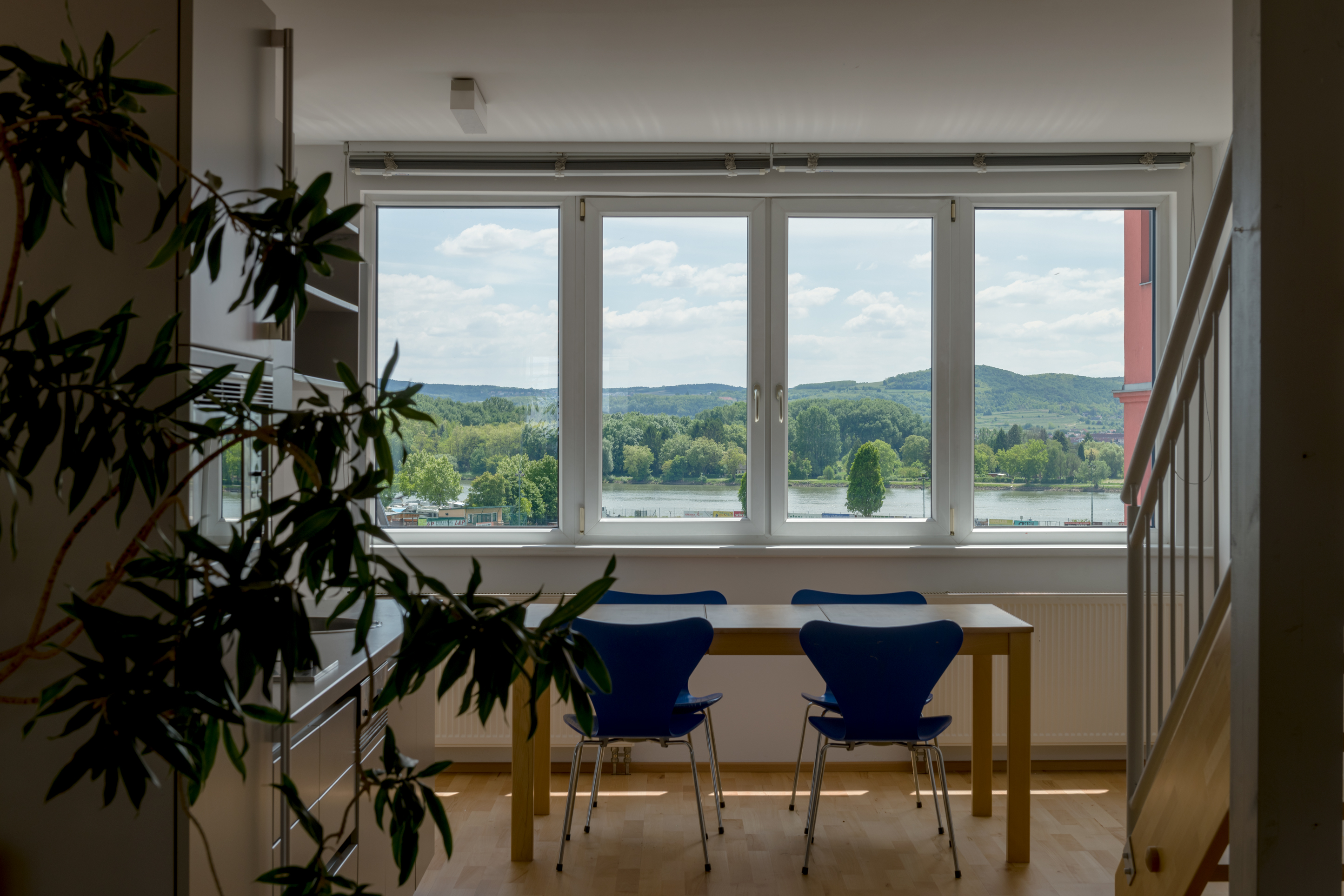
- Studio apartment / live-work space – one of five fully equipped studio flats, often with a separate sleeping area, work area, kitchen, bathroom, and sometimes a terrace overlooking the Danube.
- Stipend – a grant of around €1,950 for the residency period. Some listings mention that this can include or exclude travel support depending on the format; always check the current call.
- Common spaces – a large communal room (often referred to as AIR Base or Studio 25), shared work and meeting spaces, and sometimes access to small event rooms.
- Technical support – access to certain equipment like projectors, a sound system, basic tools, and in some cases a piano for musicians.
- Curatorial and staff support – regular check-ins, help with contacts, and guidance on how to plug your project into local institutions.
- Public-facing opportunities – project presentations, exhibitions, concerts, readings, workshops or open studios, depending on your discipline.
The day-to-day feel is more like being embedded in a small cultural campus than being isolated in a remote countryside residency. You can step out of your apartment and be at a museum or the river within minutes.
What the stipend actually covers
The grant is generous on paper for a five-week stay, but you still need to budget. Expect to cover yourself for:
- Travel – flights or long-distance transport to Vienna, plus the train to Krems, are often on you, unless a specific exchange program states otherwise.
- Daily costs – groceries, occasional eating out, local transport, small supplies.
- Materials and production – larger or more complex projects, printing, framing, and fabrication are usually self-funded.
- Health insurance – AIR expects you to arrive with valid coverage for your entire stay.
For low- to mid-budget work, the combination of housing plus stipend can be enough. If you work with heavy fabrication, expensive media, or assistants, consider adding external funding or scaling your project to what is realistic on site.
Who AIR suits best
AIR is a good match if you:
- want a short, concentrated working period rather than a multi-month relocation
- enjoy having museums, a literature house, and an architecture network literally next door
- are open to public presentations and talking about your work with curators, peers, and local audiences
- have a practice that can adapt to a five-week timeframe without massive production pressure
- are comfortable working in a small international group, not a huge cohort
It is less ideal if your main goal is long-term studio development with family in tow, or if you need industrial-scale production facilities.
AIR exchange and partner residencies
AIR is also a hub for international exchanges. The program collaborates with partner institutions in Europe, the United States, and Australia, as well as specific places like Nida Art Colony in Lithuania.
These exchanges have two directions:
- Incoming artists – artists hosted in Krems through an exchange framework.
- Outgoing artists – Lower Austrian artists sent abroad to partner residencies under similar conditions.
If you are based in Lower Austria, this network is an obvious way to get international opportunities via a familiar institution. If you are based elsewhere, it is worth asking whether a residency you already know is part of AIR’s partner network; sometimes that opens doors to Krems indirectly.
The city through an artist lens
Krems is not huge, which is a strength for residency life. Your studio, grocery store, river, and nearest museum are all close together, and you quickly build a mental map.
Key areas to know
- Stein
Historic riverside quarter, cobblestone streets, and direct access to the Danube. Many of the Kunstmeile venues sit between Stein and the center of Krems, so you will likely pass through here daily. - Innenstadt / old town Krems
Compact center with shops, bakeries, cafés, and practical errands. Good for everyday living and people-watching after studio hours. - Kunstmeile corridor
The stretch that links Stein and Krems and houses Kunsthalle, Landesgalerie, Karikaturmuseum, and the AIR facilities. This is your main art circuit, with both formal and informal networking points. - Danube banks and Wachau edge
Ideal for walks, photography, sound recording, and site visits. The changing light and weather on the river and vineyards are a major trigger for new work for many artists.
If you stay outside the residency and book your own housing, being near the Kunstmeile and the train station makes the logistics much easier.
Cost of living and daily rhythm
Krems is usually cheaper than Vienna but still sits within the general Austrian cost structure. With housing covered by AIR, your main expenses are food, leisure, and production.
Groceries and home cooking keep costs low, and the city has enough cafés and restaurants for occasional treats without blowing the stipend immediately. The size of the town makes walking or cycling realistic, so you are not spending much on local transport unless you commute frequently to Vienna.
Transport and access
Getting in and out is straightforward:
- International arrival – fly into Vienna, then take the train to Krems. The ride is direct on certain routes and otherwise requires a simple transfer.
- Regional trips – regular trains connect Krems with Vienna and St. Pölten, useful for openings, archives, or meeting curators based in the capital.
- Inside Krems – walking covers most needs. Bicycles are handy if you want to explore more of the Wachau during your stay.
Working, connecting, and planning your project
The strength of a residency in Krems is the balance between concentrated studio time and very accessible institutional contact. You can keep a steady work rhythm and still show up for what matters in the local program.
Institutions you will likely interact with
- Kunsthalle Krems
Shows contemporary and modern art, often with international names. Great for research, benchmark viewing, and meeting curators or visiting artists during openings. - Landesgalerie Niederösterreich
Works with contemporary and historical material related to Lower Austria. For artists dealing with regional history, landscape, or archives, this is a crucial resource. - Karikaturmuseum Krems
Essential if your work involves drawing, comics, satire, or illustration. Even if you do not, it is an unusual context that might nudge your visual language in unexpected ways. - Artothek Niederösterreich
Supports regional artists and art lending. Useful to understand how art circulates locally and what kind of work enters those collections. - ORTE Architekturnetzwerk Niederösterreich
Relevant if you touch architecture, spatial design, planning, or public space. Talks and events here can feed architectural or urban research-based projects. - Unabhängiges Literaturhaus NÖ
Key for writers and text-based artists. Readings and events make it easier to meet local authors and translators and to test new work with an audience.
AIR puts effort into connecting residents with these institutions, so mention in your proposal how your project could relate to one or several of them. That alignment can make it much easier for the team to advocate for your project internally.
Local community and events
The art scene in Krems is compact, and that is actually an advantage for visibility. If you are active, people notice. Typical forms of exchange include:
- resident presentations at AIR
- exhibitions and openings along Kunstmeile
- concerts and performances linked to music or sound art
- readings at the Literaturhaus or within AIR
- ad hoc workshops or small-scale public programs
Curators and staff from partner institutions often attend AIR events, so treat these not just as obligations but as built-in networking. Clear, accessible presentations of your work can lead to invitations later on, either locally or via AIR’s partner network abroad.
Designing a project for a five-week residency
Five weeks pass fast. You want a project that is ambitious but not self-sabotaging. A few approaches that work well in Krems:
- Research-focused work – using the residency to gather material, interview people, or work in institutional archives, with final production happening later at home.
- Iterative studio experiments – testing formats, materials, or methods and sharing them in a low-pressure presentation or open studio format.
- Context-specific responses – smaller-scale site-specific pieces, sound walks, texts, or photo series that respond to the Danube, the Wachau landscape, or specific sites in Krems.
- Cross-disciplinary collaborations – short collaborations with other residents or local musicians, writers, or architects that are feasible within a five-week timeframe.
If you know you are a slow burner, frame your proposal openly: use the time for research and testing, and do not promise a fully finished large-scale project unless you are certain you can produce it under the given conditions.
Visas, insurance, and admin
On the administrative side, a few points tend to matter:
- EU/EEA/Swiss artists – usually face minimal visa bureaucracy for short residencies, but may still need to register locally and always need valid health insurance.
- Non-EU artists – should check if their nationality requires a Schengen visa and whether the residency period fits within short-stay limits.
- Insurance – AIR expects proof of health insurance for your time in Krems. Do not leave this for the last minute.
- Stipend and taxes – the grant may count as taxable income in your home country even if it is tax-free locally. Check with your own tax regulations if that is relevant.
When you are accepted, ask the AIR team for a formal invitation letter, confirmation of grant amount, and exact dates. These documents help with visa applications and with securing additional funding at home.
Timing your stay and your application
Krems works year-round, but many artists find late spring and early autumn especially productive: better light, comfortable temperatures, and a Wachau landscape that invites you outside without winter logistics. If your project involves outdoor recording, walking, or site-based work, aim for a season that lets you spend time on the river or in nearby vineyards without weather dominating your schedule.
AIR typically announces open calls once a year. Calls often appear during autumn months for residencies the following year, but that can shift, so your safest strategy is to:
- check the official AIR website regularly: https://www.air-noe.at
- monitor listings on networks like Res Artis: https://resartis.org
- follow Kunstmeile Krems and partner institutions for call announcements
Prepare the usual residency package in advance so you are not starting from zero when calls open: portfolio, clear project proposal, concise bio and CV, and work samples that actually represent what you do now, not five years ago.
Is a residency in Krems right for you?
Krems gives you a focused, well-supported residency with a lot of institutional context packed into a small area. You do not get a massive independent underground scene, but you do get direct lines into state galleries, a contemporary art hall, a literature house, and an architecture network, all underpinned by a strong residency structure at AIR.
It is a solid choice if you want:
- a short, funded residency with housing covered
- a mix of studio time, research, and public presentation
- access to curators and institutions while working in a calm environment
- a landscape-rich setting that still lets you visit Vienna easily
It is less suitable if your main need is long-term family relocation, heavy fabrication workshops, or a huge independent artist-run scene. If your practice thrives on thoughtful conversation, structured support, and a clear five-week frame, Krems is a strong, realistic option to have on your list.