City Guide
Kjerrengøy, Norway
How to use this small Arctic community as a serious base for land art, ecological practice, and focused studio time.
Why Kjerringøy is on artists’ radar
Kjerringøy is a small coastal community in Bodø municipality, Northern Norway. What draws artists there isn’t a big city scene, but a mix of raw Arctic coastline, small-community pace, and a strong culture of land art and site-specific work.
If your practice leans toward landscape, ecology, or materials you can find under your own boots, Kjerringøy is worth a close look. You get:
- Access to beaches, rocky coast, forest, and fjord in walking or short-driving distance
- A residency ecosystem that encourages working with the land rather than just looking at it
- Connections to regional cultural programming through Bodø, including the European Capital of Culture cycle
- Time: fewer distractions, more headspace to think, test, and build
This is not where you go for non-stop openings or a dense gallery district. It’s where you go if your work needs light, weather, materials, and a small group of focused peers.
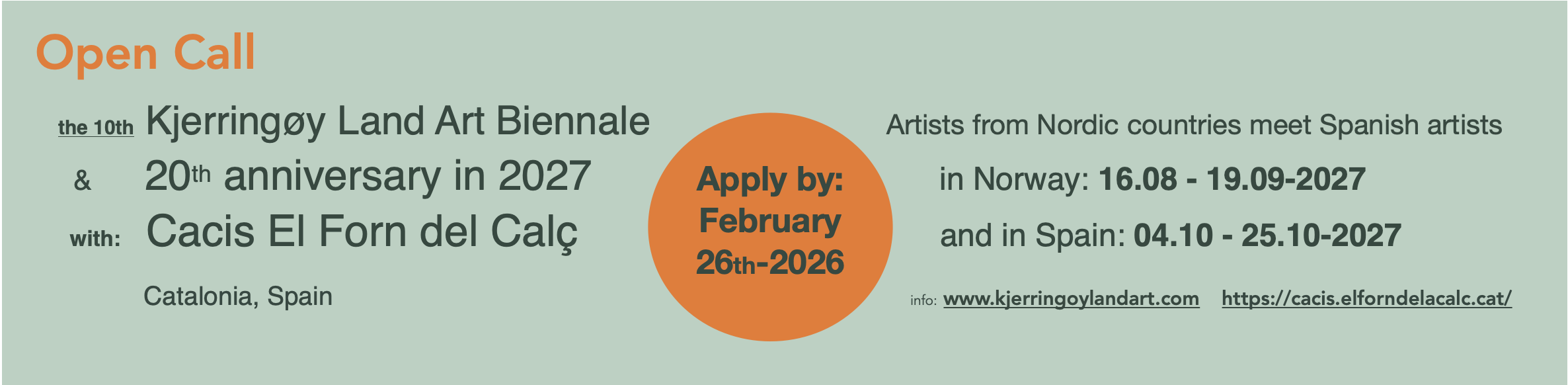
Kjerringøy Land Art Biennale (K-Lab)
The main structured residency networked to Kjerringøy is the Kjerringøy Land Art Biennale, often shortened to K-Lab. It’s artist-run, interdisciplinary, and entirely centered on land art and site-specific practice.
What K-Lab actually offers
K-Lab runs biennial projects and linked residency periods that usually stretch over two seasons. The core ideas stay fairly consistent, even as the exact format changes with each edition:
- Professional, international artists selected based on a project proposal
- Site-specific land art in and with the landscape around Kjerringøy and Nevelsfjord
- Strong focus on ecology and natural materials – works are expected to be temporary, biodegradable, or deeply integrated with place
- Public presentation built in: talks, walks, or on-site showings
- Workshops with local craftspeople and on local materials
- An intimate cohort: usually somewhere around 6–8 artists
One recent structure combined an initial residency period for research and workshops with a later return for production and presentation. That two-part rhythm lets you live with the site first, then come back with a clearer plan.
Support and practical conditions
For recent editions, K-Lab has offered a solid package for working artists:
- Travel costs covered to and from Kjerringøy
- Accommodation provided, typically in shared houses or a rented vicarage (Kjerringøy Prestegård)
- Artist fee paid, with occasional extra paid opportunities (workshops, talks)
- Access to shared studios – high-loft rooms or farm buildings converted into workspace
- Ad-hoc access to tools and shared equipment, sometimes including a ceramic kiln and graphic press
The atmosphere is project-focused but not hyper-institutional. Organizers are practicing artists themselves, so the conversation tends to be practical: site, weather, materials, local community, documentation, and how to get things built safely outside.
How the work actually happens on the ground
Expect to work mostly outdoors and to spend a lot of time walking, scouting, and testing. Previous editions have emphasised:
- Using only natural materials found on-site – wood, stone, seaweed, grass, snow, ice, driftwood
- Low-impact methods that respect the land and local ecology
- Works that either decompose naturally or sit very lightly in the landscape
- Community elements – workshops with schoolchildren, guided walks, or talks in Bodø or Kjerringøy
There is usually at least one public-facing moment where you present your process or finished work, so documentation, clear communication, and a sense of how visitors move in the landscape really matter.
Who K-Lab is a good fit for
You’re likely to get the most out of K-Lab if you:
- Work in land art, installation, sculpture, performance, or interdisciplinary practices
- Are comfortable producing work outdoors, in variable weather
- Have a practice that can adapt to limited synthetic materials and a strong ecological framework
- Enjoy small peer groups and low-key but intense exchange
- Are ready to talk about your work with non-specialist audiences
It’s less ideal if your practice depends on heavy machinery, large indoor fabrication facilities, or complex digital setups that can’t tolerate humidity, cold, or outdoor exposure.
AiR Kjerringøy and the educational strand
Connected to K-Lab is AiR Kjerringøy, an artist-in-residence program that links visiting artists with local education and workshops. This is where Kjerringøy leans into its role as both a production site and a teaching environment.
Residency structure
AiR Kjerringøy has hosted professional visual artists, musicians, authors, and other practitioners working in any medium, with stays of several weeks at a time. While formats shift, the through-lines are:
- Artist-run organisation with roots in the same team behind K-Lab
- International and interdisciplinary selection
- Accommodation in local houses or farm buildings, with shared kitchens and bathrooms
- Studio spaces adapted from vicarage rooms, barns, or similar structures
- Optional public outcomes: exhibitions, performances, screenings, or workshops
This is a little more open than the strict land-art frame of the biennale, while still being strongly shaped by place and landscape.
Connection to schools and young people
A big part of AiR Kjerringøy’s identity is its link to local schools and youth programs. Artists may:
- Lead workshops in and with nature for primary or secondary students
- Introduce basic hand tools and outdoor working methods
- Share approaches to drawing, sculpture, performance, or sound rooted in the immediate environment
- Collaborate with Nord University or local partners on teaching formats
If you enjoy building educational components into your practice, this can be a satisfying context. It can also be a way to build teaching experience and test workshop-based models for other residencies and institutions.
Balancing solitude and community
Life at AiR Kjerringøy usually combines quiet solo time with structured interactions. You might:
- Work alone in the studio or walking the coast during the day
- Share meals and process with a small group of fellow residents at night
- Have occasional meetings with the program manager to discuss your project
- Host or attend community events, open studios, or small presentations
This rhythm suits artists who want focus but don’t want to disappear completely into isolation.
Regional context: The Arctic Hideaway and beyond
Kjerringøy sits inside a broader Arctic arts ecosystem. When artists research Kjerringøy, they often encounter nearby or comparable places along the Nordland and northern coast.
The Arctic Hideaway
While not strictly a Kjerringøy program, The Arctic Hideaway shares similar coastal and climatic conditions and comes up often in the same conversations. It offers:
- Year-round artists’ stays, often self-funded
- Private sleeping cabins with workspace and Wi-Fi
- A communal studio, kitchen house, and sauna area
- Strong emphasis on solitude, quiet, and self-directed time
If you like the idea of northern coastal isolation but don’t necessarily need the intensive project framing of K-Lab or the school connections of AiR Kjerringøy, The Arctic Hideaway can function as a more flexible retreat. You set your own schedule and outcomes.
How Kjerringøy compares to more urban residencies
Compared with urban centers like Trondheim or Oslo, Kjerringøy is:
- Less equipped with workshops and fabrication facilities
- More focused on land-based, ecological approaches
- Better if you want long walks, changing light, and silence
- Less useful if you need print shops, foundries, or quick access to tech specialists
A useful approach is to think of Kjerringøy as one phase in a larger project. For example, research and site work in Kjerringøy, then fabrication or exhibition in a city-based residency later.
Working conditions: weather, terrain, and practicalities
The landscape around Kjerringøy is stunning and demanding. That tension can be great for work, but only if you plan for it properly.
Weather and light
Season matters more here than in many places:
- Late spring to summer brings long days and relatively stable conditions – ideal for outdoor installations and workshops
- Shoulder seasons can be powerful visually but more unpredictable, with wind and rapid changes in visibility
- Winter is beautiful but rough for site-based physical work unless the project is designed around snow, ice, and limited daylight
If your work depends on photography, performance, or audience visits, factor in how weather will affect access and documentation. Waterproofing, robust fixings, and a backup plan for high wind days are your friends.
Terrain and materials
You’ll meet a mix of rocky shoreline, sandy beaches, forest paths, and sometimes steep or uneven ground. For land art, that translates into:
- Plenty of driftwood, stones, and organic debris
- Strong visual contrasts between sea, mountain, and open sky
- Logistical questions: how to move heavy materials, how to work without damaging sensitive vegetation
Residency teams are usually used to artists testing new ideas in this environment, so they can advise on safe and respectful ways to work. You should still arrive with a realistic sense of your own physical limits and any equipment you rely on.
Cost of living and budgeting
Norway is generally expensive, and small coastal communities add a layer of logistics on top. If you’re on a funded program like K-Lab, major costs such as travel, housing, and an artist fee are typically covered, which makes the stay manageable.
For self-funded or partially funded stays, factor in:
- Groceries that cost more than you might expect
- Ferry or local transport costs, especially if you need to go to Bodø for supplies
- Materials that may need to be ordered in advance or shipped
- Insurance for travel and gear
Using found natural materials helps keep material budgets low but increases time investment, so plan your schedule with that in mind.
Getting to Kjerringøy and moving around
Most artists reach Kjerringøy by traveling through Bodø, the nearest city. From there, it’s a combination of road and ferry, sometimes with pickups arranged by the residency.
Arrival logistics
When you’re accepted into a program, clarify:
- Exactly how you will get from Bodø to the residency site
- What’s covered in your travel support (flights, ferries, local transport)
- How late arrivals or weather delays are usually managed
- Whether you need to bring specific tools or protective clothing
Ferries and buses in coastal Norway can be affected by weather and seasonal schedules. Build some buffer time into your arrival and departure so you are not planning site installs or public events on the same day you travel.
Local mobility
On site, you’ll largely move by foot, bike, or shared car. For land art projects, the residency may help with:
- Transporting heavier materials to and from the site
- Coordinating with landowners and local authorities
- Planning access routes for audiences during open days
The more you can design works that respond to their immediate surroundings without massive transport needs, the smoother your logistics will be.
Visas and paperwork
Norway follows Schengen rules. That means your visa situation depends on where you’re coming from and how long you’re staying.
Broadly:
- EU/EEA artists usually have straightforward entry but may need to handle registration for longer stays.
- Non-EU/EEA artists may need a short-stay Schengen visa or another type of residence or work permit, especially if you are receiving an artist fee.
Once a residency accepts you, ask them for:
- An official invitation letter with dates and description of the project
- Confirmation of accommodation and funding
- Any standard wording they use for artists applying for visas
Then cross-check current rules on Udi.no or with a Norwegian embassy or consulate in your country. Rules can change, and being precise about whether you are giving public workshops or being paid helps avoid confusion.
How to know if Kjerringøy is the right fit for your work
Kjerringøy makes the most sense for artists who:
- Want their work to be shaped directly by landscape, weather, and ecology
- Are happy with a small, focused community instead of a big city network
- Can adapt to limited equipment and variable conditions
- Value time for slow research, walking, and material experimentation
- Like the idea of sharing process with local communities and non-specialist audiences
If you need constant access to fabrication facilities, specialist technicians, or a thick web of galleries and institutions, you might use Kjerringøy as one step in a larger chain of residencies instead of your main base. Pair it with an urban residency later for fabrication or exhibition, and treat the time in Kjerringøy as research, testing, and early-stage building.
If your work has been asking for more air, more distance, and a chance to negotiate directly with rocks, tides, and local stories, Kjerringøy is a very real option to consider.