
City Guide
Kavala, Greece
How to plug into Kavala’s sea-meets-city residencies without wasting time or money
Why artists keep ending up in Kavala
Kavala sits on the North Aegean coast of Greece, built up the hillside facing the sea. The city packs a lot into a tight footprint: old fortress, port, beaches, steep streets, Ottoman and neoclassical buildings, and wide open views of the water.
Residency organizers here talk a lot about the relationship between sea, architecture, and history. That thread runs through most programs and tends to attract artists who want to work with place: how people move through a city, how coastlines shape culture, how histories overlap in one site.
Kavala makes sense if you want:
- Access to both city and sea on foot
- A visually dense environment for photography, painting, film, and urban research
- Cross-cultural context (Mediterranean, Balkan, Aegean layers)
- A smaller, less pressurized city than Athens, but still with cultural life
- Several established residency structures instead of one isolated program
It’s especially suited to visual artists, writers, filmmakers, architects, and performance artists who want to respond directly to a specific place instead of disappearing into a remote retreat in nature.
The main residencies in Kavala and how they actually feel
Eutopia Art Residency – “Sea & Urbanism”
Website: eutopiaart.com
Eutopia’s “Sea & Urbanism in Kavala” is built around the tension between the coastal landscape and the urban grid. It’s framed as an artist residency for visual artists, photographers, musicians, writers, architects, directors, actors, art historians and more.
What you get structurally
- Duration: around 3 weeks
- Accommodation: private apartments or private rooms with bathroom, kitchenette, desk, balcony, air conditioning, Wi‑Fi, and access to a washing machine
- Studios: shared indoor studios plus a large courtyard; 24/7 access
- Support: assistant curator support and help connecting with local artists and venues
- Program: visits to museums, galleries, and studios, nature and city excursions, plus a final exhibition / public event
- Extras: profiles in their digital archive, weekly cleaning and linen changes
The housing setup is comfortable rather than ascetic: proper beds, working desks, small kitchens, air conditioning. For artists who need to edit video, write, or plan complex works in the evenings, that comfort matters as much as studio space.
Who tends to thrive here
- Artists interested in urbanism, architecture, and city-sea interactions
- Those who like a clear structure: excursions, talks, and a defined end presentation
- Artists who want to meet local practitioners and engage with the city’s cultural life, not just work alone
- People who appreciate having an assistant curator to bounce ideas off and help refine a project
Questions to ask Eutopia before applying
- What scale of work is realistic in three weeks, given their schedule?
- How formal is the final exhibition and what kind of documentation do they provide?
- What tools and materials are already on site (easels, basic tools, projection options)?
- Are studio spaces better suited to painting, installation, digital work, or mixed use?
Nekubi Art Residency – artist-run and central
Website: nekubi.com
Nekubi is an artist-run residency located right in the city center (El. Venizelou 79). It highlights experimentation, connection, and community rather than a heavily institutional tone.
What the structure looks like
- Duration: around 3 weeks, with options to extend (often up to 6 weeks)
- Scale: small cohorts (about four artists) for an intimate atmosphere
- Studios: a four-level shared space of about 100 m²; 3 minutes’ walk from the beach
- Accommodation: renovated apartments a short walk from both studio and sea
- Program: a curated final event with exhibition, DJ, open bar, and promotion to their community
Because the team is artist-led, there’s usually a strong peer-to-peer feeling. The final event is less white-cube formal and more social; that can be an advantage if you are building networks or testing new work rather than presenting a polished museum show.
Who tends to thrive here
- Artists who want an artist-run environment and informal conversations about practice
- People who enjoy shared studio energy and daily interaction
- Artists looking to build international networks in a small, tight-knit group
- Those who are happy to share tools, space, and maybe sound with others
Questions to ask Nekubi before applying
- How many artists will be there at the same time as you?
- What kind of work have their residents typically shown in the final event?
- Do they support specific needs for sound, performance, or installation work?
- How is the fee structured if you come with a collaborator or partner?
Lucy Art Residency – space for free time and reflection
Website: lucyartresidency.com
Lucy Art Residency started in 2017 with a clear intention: to give artists and art professionals “free time” and a setting for new connections. It’s based out of the Lucy Hotel area in Kavala.
What stands out
- Focus on time and reflection rather than heavy production quotas
- Emphasis on networking and professional connections
- Program details can vary, so open calls are the best source of current information
Where Eutopia and Nekubi talk more about structured events and final exhibitions, Lucy leans into mental space and time. That can be useful if you are developing a long-term project, writing, or researching, and need to think more than produce.
Who tends to thrive here
- Artists or curators needing unstructured time to think, read, edit, or write
- People already mid-project who want to pause and re-evaluate in a different context
- Those who value professional networking as much as studio output
What to clarify with Lucy
- How much studio or workspace is actually available and for which practices
- Whether there are public events or the emphasis is purely on process
- What kind of peer group they tend to select (emerging, mid-career, curators, writers, etc.)
MANTILITY Artist Residency – experience-based practice
Website: mantility.com/mantility-residencies/
MANTILITY’s residency is described as a contemporary, experience-based program in Kavala, foregrounding the city’s mix of architecture, trade, and coastal identity.
What defines it conceptually
- Interest in experience-based, site-responsive work
- Attention to Kavala as a historic port and commercial hub
- Potential overlap with design, textiles, or material culture, depending on the specific call
Who tends to thrive here
- Artists dealing with material culture, commerce, or urban histories
- Those who like projects tied to context rather than purely studio-based practice
- Artists who are comfortable working within a more curated, themed framework
What to check with MANTILITY
- Residency length and how much is production vs. research
- Accommodation setup and studio infrastructure
- How they support the final form of the work (exhibition, publication, digital platform)
How the city actually feels to work in
Urban fabric and daily rhythm
Kavala has a compact center, with most residency spaces, cafés, shops, and the harbor within walking distance of each other. Steep streets create layered viewpoints and lots of visual compression: staircases, rooftops, sea, and port cranes all in one frame.
Key areas you’ll likely move through often:
- City center: where Nekubi’s space is, plus most services, cafés, and everyday errands
- Waterfront and harbor: easy access for morning walks, sketching, and photography
- Old Town / Panagia and fortress: narrow streets, historic buildings, and panoramic views; ideal for site walks, sound recordings, and architectural studies
- Nearby nature: beaches, Mount Pangaio, and the Nestos river area, often used by residencies for excursions
The city’s scale makes it easy to fall into a productive rhythm: studio in the morning, a walk to the sea, then back to work. The presence of several residencies also means you are likely to cross paths with other artists regularly.
The local art ecosystem
Kavala’s art scene is driven primarily by residencies and small organizations rather than big institutional museums. That can work well if you care more about active communities than about major-name institutions.
Typical patterns across programs:
- International cohorts: artists from different countries sharing apartments and studios
- Place-based projects: work about the coastline, old town, trade routes, migration, and urban change
- Public outcomes: group exhibitions, open studios, talks, and informal events near the end of each residency round
This ecosystem favors artists who are willing to talk about their work, attend peers’ events, and share progress as they go. Shy or very solitary practices still work, but you will get more from the city if you lean into the social parts.
Practical logistics: living, costs, and getting around
Cost of living and budgeting
Kavala is usually cheaper than major European capitals, but residency fees and seasonal housing can add up. Think in terms of two budgets: what the residency covers and what you will need on the ground.
Residency side
- Programs like Eutopia and Nekubi typically include accommodation and studio space in their fee
- Utilities, Wi‑Fi, and cleaning are often part of the deal
- Excursions or museum tickets may be extra, so factor those in if you want to join every outing
Your own budget
- Food: groceries are manageable; cooking in your kitchenette keeps costs down
- Cafés: easy to spend a lot if you write or draw in cafés daily, so set a rough weekly limit
- Local transport: in the center you mostly walk; any bus or taxi use will be for beach trips, Philippi, or mountains
- Materials: basic supplies are usually accessible, but specialty items may be harder to find, so consider bringing key tools
High summer tends to be more expensive for short-term rentals and sometimes for flights, so if you are choosing dates and are flexible, shoulder seasons can be kinder to your wallet.
Neighborhood choices
Most residencies already place you strategically, but if you extend your stay or arrive early, these areas are usually practical:
- City center: best if you rely on cafés, shops, and want instant access to the studio; good for late-night walks and easy meetup points
- Near the waterfront: ideal if daily access to the sea fuels your work or your mental health; still close to everything
- Old Town / Panagia: atmospheric and photogenic, but expect uphill walks; great if your work responds to historic architecture
- Beach-adjacent but walkable to center: works if you want quieter nights and immediate access to the water while still commuting by foot
Studios and technical needs
Residencies in Kavala typically provide shared studios and some basic tools. If your work is highly technical, check in advance so you’re not disappointed when you arrive.
Clarify:
- For painters: Are there easels, storage for wet canvases, and ventilation?
- For installation and sculpture: What tools can you use on site? Are there restrictions on noise or dust?
- For photography and video: Is there enough space to set up lights or backdrops? Any black-out options?
- For sound and performance: Are neighbors sensitive to sound? Is there an event space for showing work?
Many artists use the city itself as an extended studio: shooting video at the port, recording sound in the old town, drawing by the sea, or mapping the urban fabric. That flexibility can offset limited indoor infrastructure.
Getting there, visas, and timing your stay
How to reach Kavala
By air
- Kavala “Megas Alexandros” Airport: the closest airport, about a short drive from the city
- Thessaloniki Airport: often has more international connections; you continue by bus or car to Kavala
By bus / road
- Regular intercity buses connect Kavala to Thessaloniki and other northern Greek cities
- Residencies sometimes send clear directions from the airport they recommend using
Local movement
- Walking covers a lot of your daily needs inside the city
- Local buses or taxis are useful for more distant beaches or archaeological sites
- A rental car can be helpful if you plan frequent trips to Mount Pangaio or the Nestos river area
Visa basics
If you are an EU/EEA resident, short stays are usually straightforward. If you are coming from outside the EU/Schengen area, check visa requirements carefully.
For many nationalities, short stays in Greece fall under the Schengen short-stay rules, often allowing up to 90 days within a 180-day period. If your residency plus travel extends beyond that, you may need a different setup.
When looking at a program, ask them for:
- Invitation letter confirming your acceptance, dates, and that accommodation is covered
- Residency agreement or contract
- Any information they have on past residents’ visa experiences from your region
Always confirm details with the Greek consulate or embassy for your country; rules change, and residencies can provide support letters but not legal guarantees.
When to schedule your residency
Different seasons change the feel of your work time in Kavala:
- Spring: Mild weather, strong light, great for walking-based practices, photography, and research-heavy projects
- Early autumn: Still warm enough for sea swims, with less crowding; good for production after summer research
- Summer: Hot, bright, and lively; inspiring if you love heat and crowds, challenging if you need quiet
- Winter: Quieter, more introspective; fewer tourists and beach activities, but you gain stillness and different atmospherics
When you look at open calls, align the season with your practice. If your work depends on outdoor filming, performance in public space, or daily sea swims, avoid the coldest months. If you want to write or edit in peace, off-season can be ideal.
How to choose the right Kavala residency for your practice
Instead of asking which residency is “best”, match the structure to the way you actually work.
Choose Eutopia if you want:
- Curatorial support and help shaping a project
- Structured excursions and research into urbanism and landscape
- A formal end-of-residency exhibition and documentation
- A comfortable private living setup with strong shared spaces
Choose Nekubi if you want:
- An artist-run, intimate environment
- Daily studio community and a sociable final event
- A central location a few minutes from the beach
- A short, focused production window
Choose Lucy Art Residency if you want:
- Unpressured time to think, write, or reframe your practice
- Networking with art professionals without a heavy exhibition demand
- A residency built around the concept of “free time”
Choose MANTILITY if you want:
- A themed, experience-based context tied to urban identity and material culture
- To connect contemporary work with trade, design, or architecture
- Guided, site-specific engagement with the city
Before you apply to any of them, list your non-negotiables: specific studio needs, quiet vs. social atmosphere, required documentation, or budget limits. Compare that list against each program’s structure, ask direct questions, and read past residents’ experiences when you can.
Kavala works well when you treat the city and the residency as collaborators rather than just backdrops. The sea, the old town, the port, and the people running these programs are all part of the work you make there. If you align your expectations with the character of each residency, you can use this compact coastal city as a serious engine for your practice.
Residencies in Kavala
Gaia Ceramics
Kavala, Greece
The Gaia Ceramic Workshop spans seven days of focused engagement, with twenty five hours activity designed for beginners, ceramic enthusiasts, and aspiring artists keen to develop their skills. The workshop includes cultural excursions, exploration of the city’s historic sites, and culminates in a group exhibition—perfect for discovering, creating, and expressing yourself through ceramics.Residency Programme since: 2018Description of Organisation: Gai

Lucy Art Residency
Kavala, Greece
The Lucy Art Residency in Kavala, Greece, offers visual artists focused on photography a two-week stay with accommodation, meals, transportation, and a small stipend provided in the five-star Lucy Hotel. Artists participate in public talks and are commissioned to create a new artwork inspired by their time there. The program, launched in to foster free time for artistic exploration and networking, announced a break after six years.
nekubi art residency
Kavala, Greece
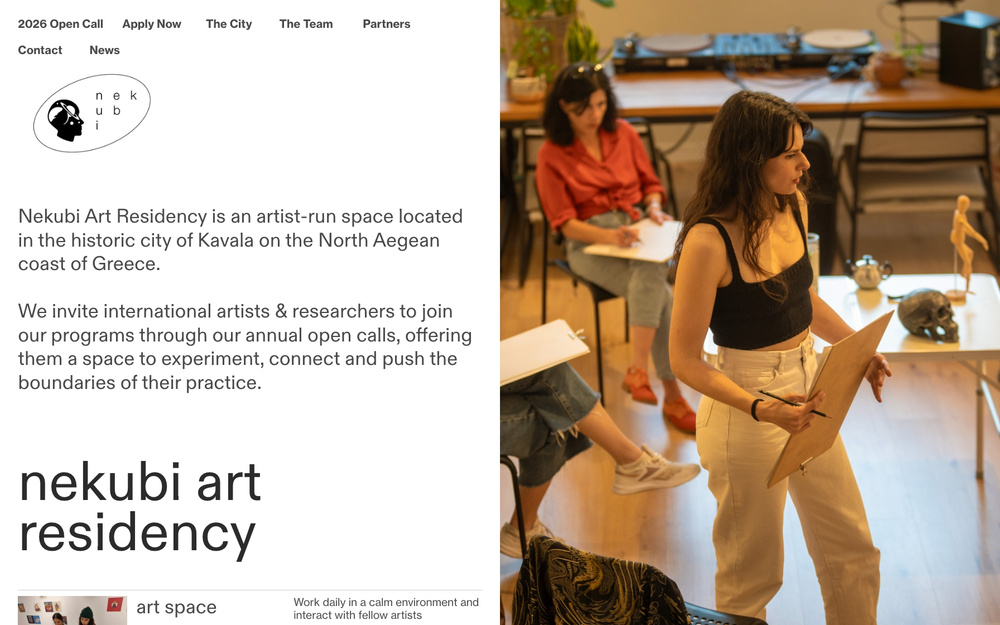
The residency program offers: shared working studio space accommodation exhibition space curated event at the end of the program (exhibition of works, open bar, DJ’s, promotion to our community)RESIDENCY LENGTH: 3 WEEKS or 6 WEEKS The are two residency program options (3 or 6 weeks). Residency programs are open to artists based anywhere in the world.Residency Programme since: 2022Description of Organisation: We are an artist run cultural space in the form o
Explore Greece
More city guides
Opportunity Intelligence
Ready to find your next residency?
Get a personalized shortlist — scored against your practice, discipline, and what you need right now.
See how Intelligence works →