
City Guide
Chicago, United States
How to plug into Chicago’s residency ecosystem, from year-long studios to short, intense production sprints.
Why Chicago is a strong residency city
Chicago hits a specific sweet spot: big-enough art infrastructure, serious production facilities, a history of artist-run spaces, and costs that are often less punishing than the coastal hubs. If you’re looking at residencies here, you’re stepping into a city that takes both experimentation and community seriously.
On the institutional side, you have anchors like the Art Institute of Chicago, Museum of Contemporary Art Chicago, National Museum of Mexican Art, Smart Museum of Art, plus a dense network of university galleries and project spaces. On the grassroots side, you’ll find collectives, DIY venues, neighborhood-based projects, and artist-run initiatives that shape a lot of the city’s energy.
The city tends to favor work that is:
- socially engaged or community-centered
- public-facing or interactive
- experimental and hybrid (performance, installation, research-based)
- rooted in neighborhoods rather than only in the downtown core
At the same time, there is a solid market-facing gallery scene, especially in West Town, River West, Pilsen, and the West Loop. Many residency artists end up circulating between community spaces and these gallery corridors.
Key residency programs in and around Chicago
Chicago’s residency ecosystem is a mix of studio-focused programs, community-engaged platforms, and high-production labs. Below are some of the central players and what they’re actually like on the ground.
Hyde Park Art Center – Radicle Studio Residency
Location: Hyde Park (South Side)
Length: Year-long studio residency
Focus: Chicago-area artists, equity-centered practices
The Radicle Studio Residency at Hyde Park Art Center is a year-long program designed to give local artists rooted time in a serious studio environment. “Radicle” refers to the first root emerging from a seed, and that metaphor is taken seriously here: the idea is to give you a year of stable conditions so you can take risks, develop deeper projects, and connect with a broad public.
What you actually get:
- A private locked studio (roughly 300–600 sq. ft.)
- 24-hour access to the space
- Staff support and professional development
- Studio visits with local and visiting curators and collectors
- Participation in Art Center events, open studios, and public programs
Who it’s built for:
- Artists who truly need dedicated studio space and don’t have it
- BIPOC artists, trans and non-binary artists
- Artists focused on equity, social justice, or community-centered work
- Artists with non-traditional training or career paths
- People who actually want to engage with a public-facing institution, not hide out
Practical notes: Residents must live in Chicago or neighboring suburbs, be 21 or older, and not be enrolled in a degree program during the residency. Expect to be in conversation with the Art Center’s community rather than isolated in a studio tower.
Monira Residency Chicago
Location: Chicago (often linked to Pilsen area)
Length: 12 months
Focus: Established working artists, all media
The Monira Residency Chicago is a straightforward studio residency for one artist at a time: 12 months, one private studio, minimal extras, strong emphasis on making.
What you actually get:
- Private 300 sq. ft. studio with basic furniture
- Internet, electrical access, and a small portable sprung wood dance floor (useful for performance or movement research)
- A modest honorarium to support your work
Who it fits:
- Artists who already have a developed practice and just need a stable, private studio
- Interdisciplinary artists mixing visual work with performance or movement
- Artists who don’t need live/work housing but do need separation from home
Eligibility basics: 21+, U.S. citizen or resident during the residency, not enrolled in a degree program, and not in another residency at the same time. The application usually focuses on strong documentation and a clear statement about how you’ll use the year.
3Arts Residencies and Bodies of Work
Location: Chicago and national partners
Length: Varies; Chicago-based residencies often around three months
Focus: Dance, music, theater, teaching artists, visual arts, strong support for Deaf and disabled artists
3Arts works differently from a traditional single-site residency. It partners with host organizations (nationally and in Chicago) and offers funded residencies to artists in its network. For Chicago, one of the most important collaborations is with Bodies of Work, which centers Disability Arts & Culture and Deaf/disabled artists.
What’s on the table:
- All-expenses-paid residencies through partner sites, often with airfare covered
- Stipends to support your time (for out-of-town residencies and for some in-town partners)
- Accessibility support, including travel and housing for personal assistants for Deaf and disabled artists
- Three-month, customized, in-town residencies for Deaf and disabled artists through Bodies of Work
Who this path suits:
- Performing artists, teaching artists, and visual artists
- Deaf and disabled artists seeking an explicitly accessible residency structure
- Artists who want a residency that doubles as professional development and advocacy
This route is especially relevant if you’re already connected to Chicago’s disability arts community or you want to be.
Lillstreet Art Center Residencies
Location: Ravenswood (North Side)
Length: Year-long and 9-month programs
Focus: Ceramics, metals, drawing/painting, printmaking & book arts, textiles
The residencies at Lillstreet Art Center are ideal if your work is materially hungry: clay, metal, print, textiles, or cross-disciplinary making. You’re embedded in a teaching center with serious equipment and a constant flow of students and studio members.
Program structure:
- Year-long residencies for Ceramics and Metalsmithing
- 9-month residencies for Drawing & Painting, Printmaking & Book Arts, and Textiles
What you get:
- Personal workspace inside active studios/classrooms
- 24-hour access to facilities and equipment (kilns, presses, etc.)
- Free classes across six departments
- Paid opportunities to teach or assist classes
- A solo exhibition
- A monthly stipend
Who thrives here:
- Artists who want to deepen technical skills in a specific medium
- People interested in teaching and community engagement
- Artists who like a social, education-centered environment rather than quiet isolation
This residency can function as both a studio base and a teaching lab. If you want to build a portfolio of classes or workshops, it’s especially useful.
LATITUDE Chicago – Artist in Residence
Location: Chicago (often near West Town/West Side studio clusters)
Length: One month
Focus: Production-heavy work, imaging, print, photo, digital experiments
The LATITUDE Artist in Residence is a one-month, high-intensity production residency based in a digital lab environment. Think scanning, large-format printing, and image-based experimentation, supported by staff who know the equipment inside out.
What’s included:
- Full access to LATITUDE’s facilities and community
- Unlimited scanning
- Ink stipend for printing
- A personal workstation and viewing wall
- Training and guidance from staff
- An organized public event to present your work
- Ongoing lab perks after your residency ends
Who this works for:
- Photographers, print-based artists, and digital image-makers
- Artists needing to produce a body of editioned work, prints, or proof-of-concept experiments
- Artists comfortable mentoring others and being visible in a community setting
The timeline is short, so the artists who benefit most arrive with a clear production plan and files or negatives ready to go.
Arts + Public Life – Artist Residencies
Location: Washington Park (South Side), linked to the University of Chicago
Length: Varies by program
Focus: Local artists, community-rooted practices, public programming
Arts + Public Life (APL) is built around the idea that artists are integral to neighborhood life. Residency programs operate in Washington Park and often connect to broader South Side cultural networks.
What to expect:
- Workspace and on-site residency support
- Public programming such as workshops, talks, screenings, dinners, and open studios
- Direct engagement with Washington Park and South Side communities
Who it’s for:
- Artists already engaged with community work or eager to develop it
- Practices that blend art with education, organizing, or social practice
- Artists who see public programming as part of their work, not an add-on
This is a strong fit if your practice is already thinking about neighborhood-scale impact, not just institutional circuits.
ACRE Residency
Location: Rural Wisconsin for the residency; Chicago as urban base for exhibitions and community
Length: Short sessions (typically several weeks)
Focus: Experimental artists, community-driven work
ACRE (Artists’ Cooperative Residency & Exhibitions) is technically outside the city, but it’s tightly woven into Chicago’s scene. The rural residency sessions are combined with ongoing exhibitions and programming in Chicago throughout the year.
Key elements:
- Artist-run and community-driven structure
- Short, immersive summer sessions with visiting artists and faculty
- Workshops, communal activities, and shared resources
- Post-residency exhibitions and programs in Chicago
Who tends to connect here:
- Artists open to collaborative, peer-led environments
- Experimental or research-based practices
- Artists who want long-term community beyond a single residency session
Ragdale
Location: Lake Forest, IL (north of Chicago)
Length: Usually 18-day sessions
Focus: Writers, visual artists, composers, and interdisciplinary artists
Ragdale is a historic estate turned residency that functions as a quiet retreat compared to many of Chicago’s more public-facing programs.
What you can count on:
- Uninterrupted work time in a scenic, historic setting
- Studios tailored to different disciplines
- Community dinners with a small cohort of residents
- Access to an 80-acre wilderness preserve and prairie
Ragdale is a good complement to more socially intensive residencies in the city. Many Chicago-based artists use it to reset, draft major projects, or finish a body of work.
Where residencies sit in the city: neighborhoods and cost of living
Residencies plug you into very different versions of Chicago depending on location. A few broad patterns help when you’re deciding where to land or where to live nearby.
Neighborhoods artists often orbit around:
- Pilsen: Galleries, murals, community spaces, and a long-standing Latino cultural presence. Relevant for Monira and many independent studios.
- Hyde Park: University-linked institutions and the Hyde Park Art Center. Strong mix of academic and community energy.
- Ravenswood: Home to Lillstreet Art Center and lots of studio buildings; good for makers and craftspeople.
- West Town / River West / West Loop: Contemporary galleries and studio buildings; rising costs but dense art activity.
- South Side neighborhoods like Washington Park: Important for artists working in community engagement and public programs, particularly through Arts + Public Life and related organizations.
- Bridgeport: Historically tied to independent studios and alternative spaces.
- Uptown / Andersonville / Edgewater: Mixed residential areas with some arts organizations and relatively accessible housing compared to downtown.
Money and logistics:
- Chicago is generally cheaper than New York or San Francisco but still requires planning, especially for housing and winter utilities.
- If your residency doesn’t offer housing, you’ll likely balance a separate apartment or room with your studio commitments.
- Some residencies (Lillstreet, Hyde Park Art Center, Arts + Public Life) are deeply tied to their neighborhood; living reasonably close can make your life easier, especially during winter.
Getting around and when to come
Transit basics:
- The CTA “L” trains and buses connect most core art neighborhoods. The Red Line is the main north–south spine; the Green and Orange Lines are key for parts of the South and West Sides.
- Metra commuter rail helps reach suburban and regional locations, including some access points toward Ragdale’s general direction (though you’ll still need ground transport from stations).
- O’Hare and Midway airports are both connected to the train system, which makes residency travel fairly manageable without a car.
You can function in Chicago without a car if you’re near transit, but a bike or shared-ride budget helps, especially for studios that are a bit off the main train lines.
Seasonal realities:
- Spring and fall: Comfortable weather for open studios, walking between galleries, and exploring neighborhoods.
- Summer: Heavy concentration of festivals, outdoor arts programming, and public events.
- Winter: Cold and sometimes intense, but excellent for focused studio time if you’re already set up with heat and transport figured out.
Visas, access, and choosing the right fit
For international artists:
Residencies in Chicago vary a lot in how they handle visas. Short stays are sometimes possible under visitor status, but as soon as you add teaching, stipends, or significant public programming, you need to think carefully about immigration categories. Most U.S. residencies do not sponsor visas directly, so you should:
- Ask programs if they can provide invitation letters or documentation
- Clarify whether stipends are treated as taxable income
- Confirm whether any paid teaching, performances, or honoraria affect your visa type
Always cross-check residency conditions with up-to-date visa guidance for your specific country and situation.
Accessibility and support:
For Deaf and disabled artists, 3Arts and Bodies of Work have intentionally designed structures with personal assistant support, stipends, and accessibility planning. Other residencies may accommodate access needs case by case, but it’s worth asking specific questions about:
- Building access (elevators, door widths, bathroom accessibility)
- Communication access (interpreters, captioning, written materials)
- Flexible scheduling for public programs and deadlines
Matching your practice to a Chicago residency
If you’re scanning this and trying to quickly see where you fit, here’s a simple way to pair your practice with the programs above.
You mainly need long-term local studio space:
- Hyde Park Art Center – Radicle Studio Residency if you want institutional support plus community visibility.
- Monira Residency Chicago if you want a quiet, dedicated studio for a year with minimal obligations.
- Lillstreet Art Center if your work is material-heavy and you also want teaching opportunities.
You’re a craft or material-based artist:
- Lillstreet for ceramics, metals, textiles, printmaking, and drawing/painting with serious tools.
- LATITUDE if your craft is more about imaging, print output, or hybrid digital/analog workflows.
Your practice is community-centered or socially engaged:
- Arts + Public Life for South Side, neighborhood-rooted work and public programming.
- Hyde Park Art Center if you want to tie social practice to a major community institution.
- ACRE if you want peer-based experimentation, then ongoing Chicago programming.
You’re Deaf or disabled and want explicit accessibility support:
- 3Arts + Bodies of Work residencies for tailored access, stipends, and a disability arts framework.
You want short, intense focus time:
- LATITUDE Artist in Residence for a one-month production sprint with digital imaging support.
- Ragdale for retreat-style quiet in 18-day sessions just outside the city.
Takeaway for artists considering Chicago
Chicago is especially strong if you want real studio infrastructure plus contact with institutions, community, and peers. You can anchor yourself in a residency like Hyde Park Art Center, Monira, or Lillstreet for long-term studio access, then plug into shorter, focused experiences like LATITUDE, ACRE sessions, or Ragdale to push specific projects forward.
If you choose a residency here, think about three things clearly: what you need materially (space, tools, time), how much community you want (teaching, public programs, collaborations), and how you want to relate to the city’s neighborhoods. The programs above give you different combinations of those three. Once you know your mix, Chicago has a residency that probably matches it.
Residencies in Chicago

Hyde Park Art Center
Chicago, United States
The Jackman Goldwasser Residency at Hyde Park Art Center in Chicago offers international and local artists a space to focus on their creative practices within a vibrant community. The program supports residents with studio space, exposure to a broad network, and engagement opportunities through public programs such as open studios and artist talks. Residencies vary in duration, with local artists potentially staying up to a year and international artists for shorter periods. The program emphasizes cross-cultural exchange and deeper connections within the global artistic community.

Latitude Chicago
Chicago, United States
Latitude Chicago's Artist in Residence Program offers a dynamic environment for artists to enhance their creative process through full access to cutting-edge production facilities. Launched in 2013, this one-month residency annually hosts 8-10 artists, providing them with unlimited scanning, an ink stipend, a personal workstation, and invaluable training and guidance from skilled staff. Additionally, artists benefit from lifetime free lab access and the opportunity to engage with the community through mentoring and organizing public events. The program is designed for artists interested in exploring new production techniques and engaging in educational activities, regardless of their prior experience in art media or printing.
Lycée Français de Chicago
Chicago, United States
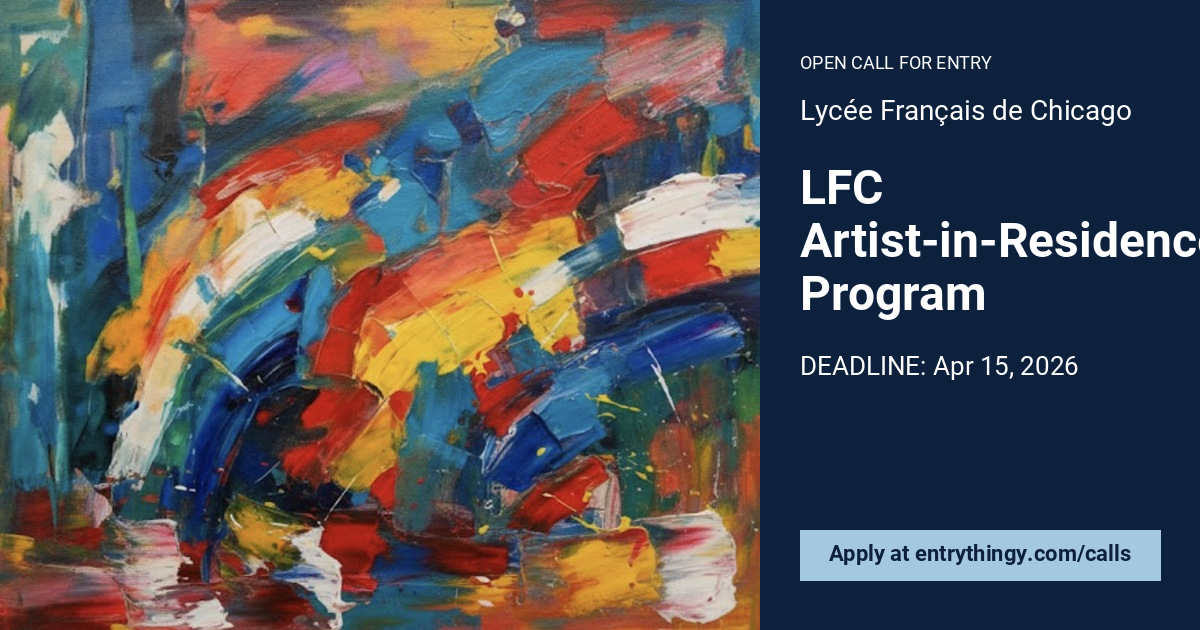
The LFC Artist-in-Residence Program at Lycée Français de Chicago invites international creators to develop artistic projects within a school setting, fostering dialogue between artists and the community every other year. The fully funded residency covers travel expenses, provides housing accommodations, and offers stipends to support artists' work and living costs.
Explore United States
More city guides
Opportunity Intelligence
Ready to find your next residency?
Get a personalized shortlist — scored against your practice, discipline, and what you need right now.
See how Intelligence works →