City Guide
Bern, Switzerland
Bern is compact, well-connected, and strong on exchange, which makes it a smart place to land if you want studio time with real local contact.
Bern is Switzerland’s federal capital, but for artists it feels more like a compact, networked city than a big political center. That matters. In Bern, you can move quickly between studios, institutions, cafés, and project spaces without spending half your day in transit. If your residency needs include conversation, visibility, and an easier way into the local scene, Bern is a strong place to look.
The city is also less saturated than Zürich or Basel. That can be a real advantage when you want to meet people, not just pass through openings. Residencies here often reward process, exchange, and public presence rather than pure retreat.
Why Bern works for residency artists
Bern’s scale is one of its biggest strengths. The art scene is serious, but still manageable. You can build relationships quickly, especially if your residency encourages studio visits, talks, open studios, or small presentations. In a city this size, those contacts can turn into invitations, collaborations, or repeat visits after your residency ends.
The cultural setting is mostly German-speaking, but English and French are common in arts contexts. If you are arriving from abroad, that makes day-to-day logistics easier than you might expect. You do not need perfect language skills to function well here, though learning a few practical phrases helps.
Bern also sits inside a wider Swiss network. Trains make it easy to reach Basel, Zürich, Lausanne, Lucerne, Thun, and Interlaken, which is useful if your residency involves studio visits, partner institutions, or exhibition hopping across the country.
Residencies to know in Bern
PROGR – Zentrum für Kulturproduktion
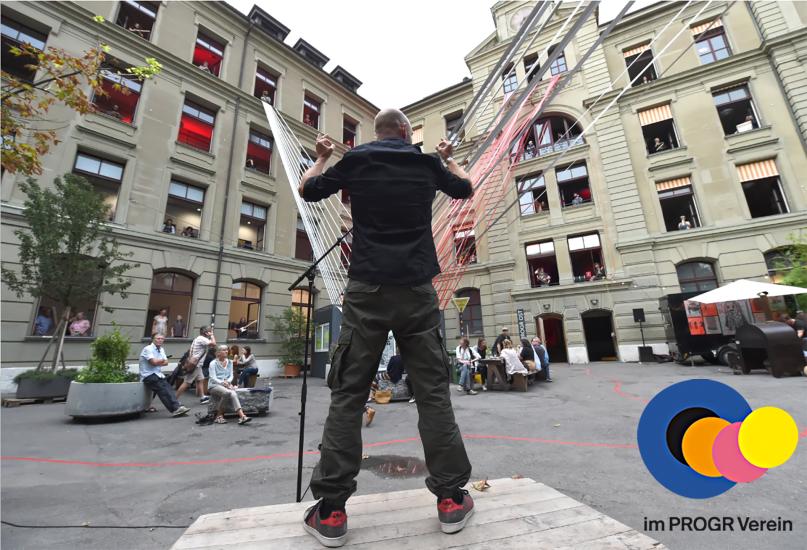
PROGR is one of the key addresses for artists in Bern. Housed in a former school building in the city center, it functions as a cultural production hub with studios, workspaces, galleries, a café, a bar, and event spaces. Art Basel has described it as a 4,500-square-meter, five-story complex, and that scale is part of its appeal: there is room for many kinds of practice, and plenty of chances for informal exchange.
For visiting artists, the residency model is especially useful if you want to be folded into a working community rather than hidden away. Artists in residence are accommodated in an apartment on the top floor and connected directly to the building’s mix of creative enterprises and cultural activity. That setup suits artists who want contact with local practitioners, not just a quiet studio.
PROGR is also tied into broader funding routes. Pro Helvetia supports one or two residencies there each year, and artists are often awarded via Residency.ch. If you are eligible, this is one of the most practical entry points into Bern.
Pro Helvetia residency programme
Pro Helvetia is the Swiss arts council, and its residency programme is important if you are looking at Bern and the wider Swiss system together. The residencies can run for up to three months and are shaped around artistic exchange, reflection, and the possibility of new collaborations or works. Some end with public presentations; others are quieter and more research-led.
For Bern, the main thing to understand is that Pro Helvetia supports residencies at PROGR and also operates a broader system for eligible artists in Switzerland and in the regions covered by its liaison offices. If your practice fits the criteria, this route is worth serious attention.
One useful feature of the programme is its flexibility. It does not force every resident into the same outcome. If your work needs time, quiet, and room to think, that can be a good fit. If you want public exchange built into the residency, that can work too.
Here! Am / artlink in Bern
Here! Am, run by artlink, is aimed at artists with refugee or migration experience who have recently relocated to Switzerland. This is a very specific program, but an important one. It offers practical support that goes beyond a studio key: accommodation in autonomous studios with living and working space, a small kitchen, a bedroom, shower facilities, per diems, and travel expenses within Switzerland.
For artists rebuilding practice after displacement or relocation, that kind of structure can make a real difference. The Bern edition sits inside a support model that understands how unstable the early stages of re-settling can be.
What the city feels like on the ground
Bern is expensive, but usually a little less intense than Zürich. Housing is still the biggest cost, and furnished temporary places can be hard to find. If your residency covers accommodation, that changes the equation a lot. Without housing support, a temporary stay can get costly fast.
For longer stays, areas like Länggasse, Lorraine, Breitenrain, and Mattenhof are often practical to explore. Länggasse is close to the university and the center. Lorraine has a neighborhood feel and a creative social rhythm. Breitenrain is lively and mixed, with a good food and café scene. Mattenhof and nearby areas can be more residential and sometimes easier on the budget.
The Old City is beautiful and central, but it is not always the easiest place to find space. If you need room for work rather than postcard views, look beyond the obvious center.
Studio space can be competitive, so it helps when a residency connects you to local networks. Ask hosts whether they can introduce you to studios, project spaces, or artist-run initiatives. In Bern, a warm introduction still goes a long way.
Institutions and spaces that shape the scene
Bern’s art infrastructure is compact but strong. A few places matter especially if you want to understand how the city works.
- Kunsthalle Bern for contemporary art exhibitions and a serious institutional presence.
- Kunstmuseum Bern for major collections and exhibitions.
- PROGR for production, studio life, and local exchange.
- Kornhausforum for exhibitions and public programming.
- Dampfzentrale Bern for performance, dance, music, and hybrid work.
What makes Bern useful is not just the museums. It is the combination of institutions, working spaces, and smaller social settings where people actually meet. If your work sits between disciplines, the city can be especially generous.
Getting around and staying connected
Bern is easy to move through. Trams and buses are reliable, the center is compact enough to walk, and cycling is realistic if you are comfortable with weather and a few hills. For most residency stays, you can get by without a car.
Rail connections are excellent. That matters if you are trying to keep a wider Swiss network alive while you are in Bern. You can get to major cities and nearby cultural centers without much friction, which helps if your residency is part of a broader professional trip.
Bern does not have the same airport logic as Zürich or Geneva, so many artists arrive by train from one of those cities. That is normal here and usually straightforward.
What kind of artist Bern suits
Bern tends to work well for artists who want concentrated time with real contact. It is a good fit if you value exchange, a clear public context, and a scene that is welcoming without being overwhelming.
- Performance artists who benefit from public-facing venues and interdisciplinary circles
- Writers and researchers who want time, structure, and quiet
- Visual artists who like a smaller but engaged institutional field
- Artists whose work grows through conversation and local connection
- Practitioners who want a residency that feels integrated into everyday city life
If you are looking for nonstop international art-world intensity, Bern may feel restrained. If you want a workable city, easy movement, and meaningful contact, it can be exactly right.
How to approach Bern residencies
Start early. Swiss residency systems often involve eligibility rules, language considerations, funding details, and visa questions, so give yourself time. If you need paperwork support, ask the host directly what they provide and what they do not.
It also helps to think about the residency format before you apply. Some Bern opportunities are built around public exchange. Others are more reflective. Choose carefully. If you are hoping for solitude, do not apply to a program designed around community contact. If you want visibility, do not hide behind a retreat model.
Bern rewards clarity. The more specific you are about what you need from the city, the better your stay will probably go.
If you want a residency that combines credible institutions, manageable scale, and a real chance to meet people, Bern is one of the most practical cities in Switzerland to consider.