
City Guide
Bern, Switzerland
How Bern’s quiet capital energy, strong institutions, and a few key residencies can really support your work
Why Bern works so well as a residency city
Bern is Switzerland’s political capital, but as an artist you’ll notice something else first: the pace is slower, the center is compact, and the art scene feels surprisingly personal. You can cross the city center on foot, run into the same people at openings, and still hop on a train to Zurich or Basel in under an hour.
This is the core appeal of Bern for residencies. You get:
- A close-knit art community: Because the city isn’t huge, visiting artists tend to meet local practitioners quickly. People actually recognize each other at events.
- Serious institutions without the overload: Kunsthalle Bern, Kunstmuseum Bern, and PROGR give the city weight, but you’re not drowning in events every night.
- Space to think and produce: The city is calm enough for concentrated studio work, while still plugged into broader Swiss networks.
- Easy Swiss-wide access: Trains connect you directly to Zurich, Basel, Lausanne, Geneva, Biel/Bienne, and Lucerne, so you can attend openings or meetings across the country during your stay.
For artists, Bern is especially strong if you’re looking for a residency that favors focused work, research, and real local connections rather than constant spectacle.
Key residencies and residency pathways in Bern
Bern doesn’t have dozens of residency houses. Instead, it has a few meaningful hubs that sit at the center of the city’s cultural life. If you’re exploring residencies here, these are your most relevant entry points.
PROGR – Zentrum für Kulturproduktion
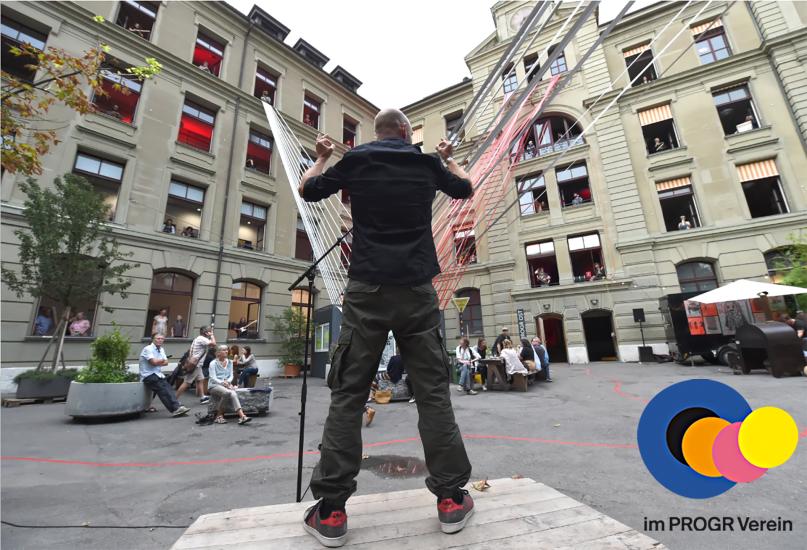
What it is: PROGR is a large art and culture center in a former school building right in central Bern. It houses artist studios, cultural organizations, exhibition spaces, and a café/bar. Think of it as a vertical village for artists and cultural workers.
Why it matters for residencies: PROGR is both a daily working space for local artists and a host for visiting residents. This means that if you land a residency here, you’re stepping into an existing community rather than an isolated studio.
What you can usually expect as a resident:
- Accommodation: Resident artists are typically housed in an apartment on the top floor of the building. You live inside the cultural center, which makes it very easy to integrate.
- Active community: PROGR is full of studios, creative offices, project spaces, and an on-site café/bar where people meet after work or events.
- Public presence: The building frequently hosts exhibitions, performances, concerts, talks, and festivals, and residents are often pulled into this programming.
Who PROGR suits best:
- Visual and interdisciplinary artists who want to be around other practitioners daily.
- Artists interested in workshops, talks, performances, and small-scale public outcomes.
- People who enjoy sharing work-in-progress and talking through ideas with peers.
How residencies at PROGR usually work:
- Pro Helvetia-linked residencies: The Swiss Arts Council Pro Helvetia supports one or two residencies per year at PROGR as part of its wider international exchange framework.
- Access points: These stays are typically accessed via platforms like Residency.ch, Pro Helvetia calls, or partner organizations.
If your priority is being embedded in a local scene rather than hiding out in the mountains, PROGR is one of the most effective places to start.
Pro Helvetia residencies in Bern
Pro Helvetia runs a broader residency program that links Switzerland and the regions covered by its liaison offices. Bern is one of the cities where international residents may be placed, with PROGR as a key host.
What the Pro Helvetia residency framework typically includes:
- Duration: Up to three months, designed to give you enough time to settle, research, and produce.
- Focus: Exchange, reflection, and new work or collaborations. Some residencies lead to open studios or presentations; others are more research-driven.
- Disciplines: Visual arts, performing arts, literature, design, interactive media, and other fields supported by Pro Helvetia.
Who can apply in general terms:
- Artists and cultural practitioners based in Switzerland who want to spend time in other regions covered by Pro Helvetia’s liaison offices.
- Artists and cultural practitioners from those regions who want to spend time in Switzerland, potentially in Bern.
If you’re based in a country connected to Pro Helvetia’s liaison offices, this is a reliable route to Bern, with structured support and a recognized institutional framework that helps with visas, funding, and future applications.
“Here I Am” at PROZESS, Bern (artlink)
Here! Am is an initiative by artlink that supports artists and cultural practitioners with refugee or migration experience who have recently relocated to Switzerland. One of the residency formats takes place in Bern, at PROZESS.
Who it’s for:
- Artists and cultural practitioners with migration and refugee experience.
- People who have recently moved to Switzerland and are building their practice in a new context.
What the residency usually offers:
- Housing: Accommodation in one of several bright, renovated studios that combine living and working space.
- Facilities: Each space typically includes a small kitchen, bedroom, and private bathroom, plus work area.
- Financial support: Per diems and travel expenses within Switzerland are part of the package.
Why this residency stands out:
- It is explicitly designed for artists with migration/refugee backgrounds, which means that the support is tuned to your situation, not just your project.
- It includes practical help like housing and local travel, which can make a huge difference when you’re just settling into Switzerland.
If you fit the target group, this program can be a powerful way not just to make new work, but to anchor yourself in a new cultural and social ecosystem.
Other Bern-linked residency opportunities
Bern often appears in Swiss residency networks in more indirect ways.
Depending on the year, you may find:
- Project-based residencies coordinated with museums, festivals, or public art initiatives.
- Short-term research stays for writers, curators, or theorists connected to universities or institutions.
- Swiss-wide programs that rotate locations and occasionally land in Bern.
The easiest way to track these rotating offers is to keep an eye on:
- Pro Helvetia
- Reviewed by Artists – Switzerland overview
- Residency.ch
- On the Move for calls and mobility opportunities
- Announcements by spaces such as PROGR, local museums, and artlink
What Bern residencies are particularly good for
Bern tends to reward artists who are looking for focus and careful development rather than constant exposure. The residencies above are particularly strong for:
- Research and development: Time to map out a new body of work, test materials, or build a long-term project idea.
- Local exchange: Meeting curators, other artists, and cultural workers in a scene that is large enough to be interesting but small enough that people remember you.
- Cross-disciplinary practice: Many Bern spaces host visual arts, performance, music, literature, and hybrid forms in close proximity.
- Smaller-scale visibility: You might not be in a global art-fair city, but you can get thoughtful exposure in respected institutions and project spaces.
If you prefer a highly commercial scene, endless nightlife, or a constant stream of big-ticket openings, Bern may feel quiet compared with Zurich or Basel. If what you need is dedicated work time, strong institutions, and real relationships, it’s a very effective residency city.
Living and working in Bern during a residency
Residencies are not only about the studio. Daily life, transport, and how you move through the city will shape your work rhythm. Bern scores well on practicality, but you’ll want to plan for Swiss prices.
Cost of living and budgeting
Bern is expensive by global standards, even if it’s slightly gentler than Zurich.
Main cost areas to keep in mind:
- Housing: If your residency covers accommodation, that’s a huge financial relief. Renting privately for a short stay can be costly.
- Food: Eating out often will burn through your budget quickly. Groceries are also pricey compared with many countries, but cooking at home makes a big difference.
- Transport: Public transport is efficient and reliable but not cheap. A local transit pass pays off if you’re commuting regularly.
- Studios and materials: When not included, studio rent and materials can stretch a small budget, especially for large-scale or material-heavy practices.
Practical budgeting strategies:
- Use supermarkets like Migros and Coop, and look for their budget lines.
- Take advantage of lunch menus and canteens instead of frequent dinners out.
- Ask your residency or peers about shared tools, workshops, or group orders for materials.
- If your residency stipend is modest, plan your own savings to top up daily costs.
Neighborhoods that work well for artists
Bern is compact, so you’re rarely very far from anything. That said, some areas are especially practical during a residency.
- Old Town (Altstadt): Historic, central, and UNESCO-listed, with arcades, shops, and quick access to most cultural venues. Beautiful but can be more expensive and touristy.
- Länggasse: A lively, student-leaning neighborhood with easy access to universities and institutions. Good for a mix of residential, cafés, and proximity to central Bern.
- Kirchenfeld: Leafy, residential, and close to several museums. Quiet, with a slightly more “embassy” feel.
- Breitenrain: A lived-in, pleasant area with a local feel and decent tram connections to the center. Popular with many creative workers.
- Matte and nearby river areas: Down by the Aare river, atmospheric and central, with a more tucked-away feeling. Flood risk and noise can be factors near the water, so check the exact location.
If your residency assigns you a specific apartment or studio, you probably won’t be choosing your neighborhood. Still, understanding where you’re located helps you build realistic travel times and social expectations into your days.
Studios, tools, and production resources
The Bern art ecosystem leans on existing institutions rather than huge industrial districts. For many visiting artists, this is an advantage.
Typical working setups during residencies:
- In-house studios: PROGR and similar centers often give residents a studio within the building, sometimes combined with living space.
- Shared spaces: You might be working next to local artists, which opens up opportunities for tool sharing and informal feedback.
- Institutional workshops: For certain disciplines, you may have access to technical workshops or labs through host institutions or partners. Confirm this with your residency before you arrive.
Ask early about:
- What furniture and equipment is already in your studio.
- What’s allowed in terms of noise, chemicals, and late-night work.
- Whether there are print shops, woodshops, metal shops, or digital labs you can use nearby.
Galleries, institutions, and where to show up
To get a feel for the city’s cultural circuits, a few names are worth knowing:
- PROGR: Studios, events, project spaces, and a bar that functions as a social hub. Many residencies intersect with this building in some way.
- Kunsthalle Bern: A historically important institution for contemporary art, often with forward-looking programming.
- Kunstmuseum Bern: The main art museum, with historical collections and contemporary shows.
- Regional nodes: Places like Centre Pasquart in nearby Biel/Bienne are outside Bern but often part of the same mental map for artists in the area.
On top of this, smaller artist-run spaces and independent projects come and go. Ask your residency host and local artists for current recommendations, and show up regularly to openings and talks. In a city this size, two or three consistent appearances already put you on people’s radar.
Getting around, visas, and timing your stay
Transport and mobility
Bern is very forgiving when it comes to getting around, especially if you prefer not to drive.
Within the city:
- Walkable center: The historical core and many cultural spaces are within reasonable walking distance.
- Trams and buses: A well-organized network connects most neighborhoods. Services are frequent and punctual.
Beyond Bern:
- Train connections: Direct trains link Bern to Zurich, Basel, Lausanne, Geneva, Lucerne, and Biel/Bienne. Day trips for openings or meetings are very realistic.
- Train passes: If you plan regular travel across Switzerland, look into regional or national passes; even a short-term option can save money.
As a resident artist, this mobility means you can build a Swiss-wide network while still having a calm base in Bern.
Visas and legal stay
The practicalities of entering and staying in Switzerland depend heavily on your passport and the length of your stay, so always double-check official information.
Rough orientation:
- EU/EFTA artists: Generally face fewer barriers for short stays, but may still need to register locally if staying longer or receiving payment.
- Non-EU/EFTA artists: Often need a visa and potentially a residence permit, especially for stays beyond a tourist period or for funded work.
What to ask your residency:
- Do they provide an invitation letter or contract for visa purposes?
- Is your housing officially registered, and does the residency help with local registration?
- How is your stipend or fee paid (account options, currency, timing)?
- Have they hosted artists with your nationality before, and do they have tips on the process?
Switzerland is strict about immigration rules, so don’t assume that a residency acceptance automatically covers all legal aspects. Start the conversation with your host early and factor in the administrative timeline.
When to be in Bern
Bern works differently across the year, and that can matter for your practice.
- Spring: Lively but not too hot, good for getting to know the city and attending a steady stream of openings and events.
- Summer: Long days and river-swimming season in the Aare. Some institutions slow down or shift focus, but life moves outdoors and can be great for public or site-specific work.
- Autumn: Often a strong period for exhibitions, festivals, and networking, with more structured programming after the summer calm.
- Winter: Darker and colder, which can be perfect for concentrated studio time and introspective projects.
Application cycles for residencies can land at any point in the year. As a rule, calls often go out many months ahead of the actual residency period, so keep your calendar open for planning at least a year in advance.
How to approach a residency in Bern strategically
To make the most of a Bern residency, it helps to think beyond just “time to work” and build a simple strategy.
Clarify what you want Bern to do for your practice:
- Is this a research phase for a larger project?
- Do you want connections in Swiss institutions and networks?
- Are you testing out a new medium, and need workshops and peer feedback?
Map your potential hosts to those goals:
- PROGR / Pro Helvetia-linked residency: Strong if you want dense contact with local artists, curators, and interdisciplinary events.
- Here I Am at PROZESS: Ideal if you have migration/refugee experience and need both artistic support and practical infrastructure as you settle in Switzerland.
- Other Pro Helvetia placements: Useful if you want an internationally recognized framework and funding structure that can support future applications elsewhere.
Once you arrive, do a few simple things early:
- Introduce yourself to neighbors in the studio building and in your corridor or floor.
- Ask your host contact which openings, talks, and project spaces are essential right now.
- Set one or two realistic public goals: an open studio, a small talk, a work-in-progress sharing, or a collaboration.
Bern rewards consistent presence and curiosity. Show up, ask questions, and give your work the time it needs. The combination of focus, institutions, and approachable scale can be a powerful mix for your next residency.
Explore Switzerland
More city guides
Opportunity Intelligence
Ready to find your next residency?
Get a personalized shortlist — scored against your practice, discipline, and what you need right now.
See how Intelligence works →